Entry & visas
Source checkedChina Visa-Free Entry Rules: Unilateral, Mutual & Transit
Check whether you need a visa for China: compare unilateral waivers, mutual visa-exemption agreements and 240-hour transit with passport-specific stay limits.
The short answer
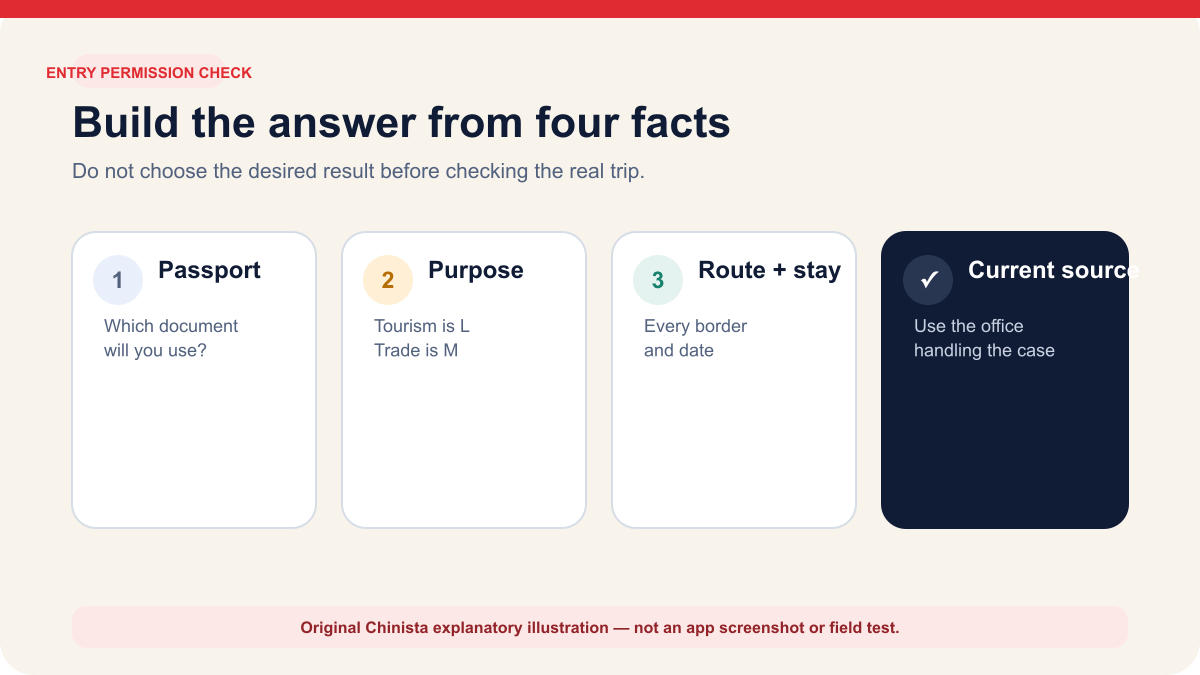
Start with the rule for your passport: a unilateral waiver or a mutual visa-exemption agreement may allow direct entry, but their document, purpose and stay conditions differ. If neither fits, check 240-hour transit only for a genuine onward route. Do not apply the unilateral waiver's repeat-entry answer to a mutual agreement; some agreements impose cumulative stay limits.
Jump to a section
Step by step
What to do
- 01
Check the passport you will actually use
Visa-free eligibility follows the ordinary passport presented for the trip, not residence, birthplace or a different passport left at home. Keep the same document across flights, accommodation and any identity-based booking.
- 02
Match the purpose to the policy
Identify the applicable unilateral waiver or mutual agreement before checking its permitted purposes and stay allowance. The unilateral 30-day rule is not a template for every agreement. Work, study, journalism and other approval-based activities need the appropriate visa or authorization when excluded by that rule.
- 03
Write every border crossing in order
Include Hong Kong, Macao and every mainland entry. A 240-hour transit requires onward travel to a third country or region; a simple return to the place of departure is not the same route.
- 04
Carry documents that explain the visit
The MFA recommends air tickets, accommodation reservations or an invitation letter to support your stated purpose. Carry them as evidence of the trip; the waiver does not require a universal advance application.
- 05
Recheck close to departure
Country lists and end dates change. Open the current MFA or embassy page for the passport and route again before buying an inflexible ticket or traveling near the policy expiry.
Start with passport, purpose, route and stay
Entry requirements depend on the ordinary passport you will present, what you will do, your complete route and the time you will spend in mainland China. Living in an eligible country does not give a different passport the same treatment. Work and long study also require the appropriate permission, even if the visit is short.
First check the direct-entry rule for your passport: a unilateral waiver or a mutual visa-exemption agreement. They are separate policies, with different document, purpose and stay conditions. Only if a direct exemption does not fit should you test 240-hour transit for a genuine onward trip to a third country or region. If none of these paths covers the trip, confirm any other applicable exemption with the responsible Chinese mission or use the visa-requirements guide.
Write out your itinerary, including every border crossing. Hong Kong and Macao have separate immigration systems and can count as a different country or region on a qualifying transit route. Permission to enter either does not cover the mainland leg. Check an official rule that covers the full journey.
| Path | Typical fit | Critical check |
|---|---|---|
| 30-day unilateral waiver | Eligible ordinary passport and listed short-visit purpose | Nationality, purpose and current policy end date |
| Mutual visa-exemption agreement | Passport category covered by the agreement with that country | Agreement-specific passport validity, purpose, stay length and any cumulative limit |
| 240-hour visa-free transit | Eligible traveler continuing to a third country or region | Onward ticket, eligible port and permitted area |
| Visitor visa | Waiver does not fit, stay is longer, or purpose needs a visa | Correct category and the responsible mission's current checklist |
What the unilateral 30-day waiver covers
The Ministry of Foreign Affairs FAQ currently lists 50 nationalities whose ordinary-passport holders may enter without a visa for business, tourism, family or friend visits, exchange and transit for up to 30 days. The United Kingdom, Canada and Australia are included; the United States is not. Most listed policies run through 31 December 2026. Check that the policy covers your entry date.
The 30 calendar days begin on the day after entry, so count the days rather than booking an approximate month. The FAQ currently allows eligible travelers to enter multiple times without a stated interval, entry-count or cumulative-stay cap. Every visit must still have an allowed purpose; repeat visits cannot replace the required work, study or residence permission.
The ordinary waiver is not limited to the designated transit ports. The MFA says it can be used at sea, road and air ports open to foreign nationals, subject to the particular port being open for that entry. This is one important difference from 240-hour transit, whose port and permitted-area rules are much narrower.
Read the agreement for your passport
The MFA maintains a separate list of mutual visa-exemption agreements. Check the passport category in the relevant row: an agreement covering diplomatic or service passports does not automatically cover an ordinary tourist passport. Then read the responsible Chinese mission's explanation of the agreement; the list alone does not provide every operational condition.
Repeat-entry rules under mutual agreements can differ from the unilateral waiver. The Chinese Embassy in Malaysia, for example, requires Malaysian ordinary passports to have at least six months' validity. Covered visits may last up to 30 days per entry, with cumulative visa-free stays limited to 90 days in any 180-day period. The embassy's FAQ explains which earlier stays count. Check the same details in the agreement that applies to your passport.
Use one complete policy to check your trip. Stay allowances, document requirements and route exceptions from different policies cannot be combined. The passport-specific guide or checker can help you find the relevant source. If it does not cover your documents and purpose, you still need to confirm eligibility.
Bring your travel records
For the ordinary 30-day waiver, the MFA requires a passport valid for the intended stay. It does not set a universal requirement for six months' validity and two blank pages for visa-free travelers. Those requirements can appear in visa application instructions or carrier practices; check which process applies to you.
The MFA recommends carrying tickets, accommodation reservations or an invitation letter that support the stated purpose. It does not describe a return ticket as a universal standalone condition for the ordinary waiver. Border inspection can nevertheless ask whether the documents and answers form a coherent short visit, so save the relevant records offline and keep names and passport details consistent.
The waiver does not guarantee admission or give you advance entry permission. Your carrier may check documents before boarding, and border inspection decides whether to admit you. Keep reservations flexible and the current official guidance accessible; a screenshot or undated third-party list may be out of date.
Check the separate 240-hour transit rules
The National Immigration Administration's 240-hour policy covers citizens of 57 countries, including the United States, United Kingdom, Canada and Australia. It requires an ordinary passport with at least three months' validity and confirmed onward arrangements to a third country or region within 240 hours. The traveler must use one of the 65 designated ports and remain inside the permitted area.
A route from country A to mainland China and back to country A is not transit to country B. A route from the United States through Shanghai to Japan may fit if every other condition is met. A change that removes the onward destination, changes the port or sends the traveler outside the allowed area can change the result, even when the original itinerary looked eligible.
Check the current ports and permitted regions on the NIA page, and keep your onward ticket available. Transit eligibility depends on the route. If you want more flexibility for a China holiday, a regular visa or an applicable ordinary waiver is usually a better fit.
When to apply for a visa
Apply before departure when the passport is not covered, the purpose falls outside the listed short visits, the intended stay exceeds the allowance, or the route does not genuinely satisfy transit. Choose the category from the activity: tourism normally uses an L visa, while work, long study, journalism and residence have their own categories and supporting approvals.
Under the unilateral 30-day waiver, a traveler planning a longer stay should arrange the appropriate visa before departure. The MFA describes a stay-permit application for a reasonable and sufficient need to remain after visa-free entry, not an automatic extension. A mutual agreement has its own stay allowance and extension conditions; do not assume that every agreement is limited to 30 days or can be renewed.
Recheck near departure, especially for travel close to 31 December 2026. Consult the MFA, NIA or the Chinese mission responsible for your passport and application location. Chinista's country pages explain how these rules affect trip plans; if a policy changes, follow the current official source.
Continue the setup
Tasks connected to this guide
When Plan A fails
Fallbacks and safety checks
- If no unilateral waiver or mutual agreement clearly covers the passport and purpose, check whether the actual trip qualifies for transit or another official exemption; otherwise use the visa requirements guide before departure.
- If the transit route depends on a self-transfer, changed ticket or travel outside the permitted area, confirm it with the carrier and the National Immigration Service Hotline 12367 before relying on it.
- If a stay must exceed the allowance of the specific exemption used, contact the local exit-entry administration before that allowance ends. Extension conditions differ by policy; approval is not automatic.
- If the airline or border authority reaches a different conclusion, use the official contact route and flexible bookings rather than treating this guide as an entry guarantee.
Common questions
Frequently asked questions
Do I need a visa to enter China in 2026?
It depends on your passport, purpose, route and stay. Check the unilateral waiver and the separate mutual visa-exemption agreements first. If neither covers your trip, qualifying transit or another specific exemption may still apply; otherwise obtain the appropriate visa before departure.
Which travelers can use China's 30-day visa waiver?
Ordinary passport holders from the current MFA list may enter for business, tourism, family or friend visits, exchange or transit and stay no more than 30 days. The policy for most countries on that list is stated to run through 31 December 2026.
Does the unilateral visa waiver require a return ticket?
The MFA FAQ recommends carrying air tickets, accommodation reservations or an invitation letter as proof of the stated purpose. It does not describe a return ticket as a universal standalone condition, but border inspection may examine whether the trip evidence supports the visit.
Can I enter China visa-free more than once?
Check the policy used for each entry. MFA's unilateral-waiver FAQ allows repeated eligible visits without a current cumulative-stay cap; each visit must still fit that waiver. Mutual agreements have their own rules: Malaysia's agreement limits visa-free stays to 30 days per entry and 90 days in any 180-day period. Do not transfer one policy's answer to another.
Can a stay under the unilateral 30-day waiver be extended?
Under the unilateral waiver, plan the appropriate visa in advance for a stay longer than 30 days. MFA describes a stay-permit application for appropriate and sufficient reasons after visa-free entry, not an automatic extension. Mutual agreements have separate allowances and extension conditions.
Is 240-hour visa-free transit the same as the 30-day waiver?
No. Transit has a separate nationality list, designated ports and permitted areas, requires confirmed onward arrangements to a third country or region within 240 hours, and is decided by border inspection. Use the ordinary 30-day waiver when your passport and purpose already qualify.
Evidence
Primary sources
Source list last checked: .
- Ministry of Foreign Affairs — unilateral visa-waiver FAQ, questions 1 and 12
- Ministry of Foreign Affairs — mutual visa-exemption agreements and passport categories
- Chinese Embassy in Malaysia — mutual agreement FAQ, passport and cumulative-stay conditions
- National Immigration Administration — current 240-hour visa-free transit policy (57 countries and 65 ports)
- National Immigration Administration — transit conditions appendix: document validity and stay calculation (3 November 2025)
- Ministry of Foreign Affairs consular service — current Visa Application Instructions