Entry & visas
Source checkedDo Canadians Need a Visa for China? 2026 Entry Guide
Canadian ordinary passport holders can visit China visa-free for up to 30 days from 17 February through 31 December 2026; check the conditions.
The short answer
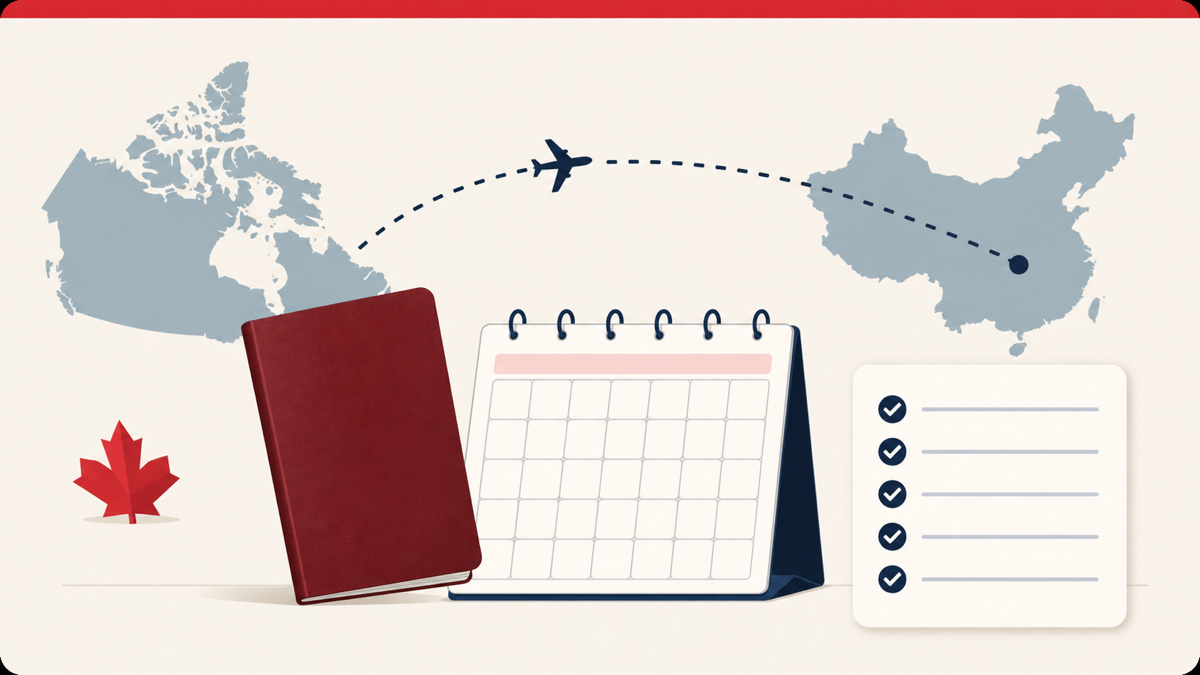
Canadian citizens holding an ordinary passport can currently enter mainland China without a visa for business, tourism, family or friend visits, exchange or transit for no more than 30 days. The measure took effect on 17 February 2026 and is stated to run through 31 December 2026; visitors outside those purposes or dates need the appropriate entry route.
Jump to a section
Step by step
What to do
- 01
Confirm the travel document
The measure covers Canadian citizens holding ordinary passports. Permanent residence in Canada, refugee travel documents and emergency documents do not by themselves prove eligibility, so check the exact document if it is not an ordinary Canadian passport.
- 02
Keep the visit inside the date window
The official notice applies from 17 February through 31 December 2026 Beijing time. A booking made while the rule is active does not guarantee that an entry after the end date will remain visa-free.
- 03
Match the visit purpose
Business, tourism, family or friend visits, exchange and transit are listed for up to 30 days. Work, study outside eligible study tours, journalism or residence require the process designed for that purpose.
- 04
Save documents that explain your itinerary
Save flight or rail arrangements, accommodation bookings and any relevant invitation information. The MFA recommends documents that support the stated purpose, and border inspection can examine your itinerary.
- 05
Arrange registration at your first address
A hotel normally completes accommodation reporting. For a private home or non-hotel stay, you or your host must complete accommodation registration within 24 hours of arrival at the accommodation; keep the confirmation.
The Canadian visa waiver in 2026
Canadian citizens holding ordinary passports can currently enter mainland China without a visa for business, tourism, family or friend visits, exchange or transit for no more than 30 days. The Chinese Embassy in Canada says the policy began at 00:00 Beijing time on 17 February 2026 and continues through 24:00 on 31 December 2026.
The passport type is part of eligibility. Refugee travel documents, certificates of identity, emergency documents and other non-ordinary documents should not be assumed to receive the same treatment. Confirm the exact document with the Chinese mission before making an inflexible booking.
The waiver does not cover employment, study outside eligible study tours, journalism or residence. Canadian tourists may use it when all conditions are met. For an activity requiring a visa or approval, complete that process before travel.
The MFA distinguishes study from study tours: ordinary-passport holders may join eligible summer or winter camps for up to 30 days. A short course is not automatically a qualifying tour; confirm the specific activity with the Chinese mission.
| Plan | Entry route to check | Do not assume |
|---|---|---|
| Canada to China and back, up to 30 days | Ordinary 30-day waiver | That the rule continues after 2026 |
| Canada to China to South Korea | Ordinary waiver or 240-hour transit | That the policies share the same limits |
| Work, study outside eligible study tours or over 30 days | Purpose-specific visa | That a short visit can be extended automatically |
Documents to carry
The MFA FAQ recommends carrying air tickets, accommodation reservations or an invitation letter that supports the purpose. It does not state that every Canadian needs a return ticket as an independent universal condition. Border inspection can still ask for evidence and decides whether the traveler may enter.
Save a short itinerary, first accommodation address and onward or return booking offline. Use the same passport data across airline, hotel and ticket reservations. If staying privately, keep the host's address and contact available and complete the applicable accommodation registration after arrival.
The MFA requires a passport valid for the intended visa-free stay. The six-month requirement found in some visa application instructions does not apply universally to this waiver. If your passport has limited validity, ask the carrier and Chinese mission early; it can be difficult to resolve a document problem at departure.
For a child traveling with one parent or another adult, also check the carrier's and Canadian authorities' consent-document guidance. These requirements are separate from China's 30-day waiver, but missing family-travel records can interrupt the journey before you reach the Chinese border.
Stay limits and ports of entry
The 30 calendar days begin on the day after entry. Use your entry record to calculate the last permitted day and allow time for a missed connection or weather delay. A booking described as one month may exceed the allowance.
Eligible Canadians may currently enter more than once, with no entry-count or cumulative-day restriction in the MFA FAQ. Each visit must have a listed short-visit purpose. Border inspection can review your travel pattern and documents, and repeat visits do not replace residence or employment permission.
The ordinary waiver is available at sea, road and air ports open to foreign nationals. That is broader than the designated ports under 240-hour transit. Confirm a particular land or ferry crossing is open, but do not apply transit-only regional limits to an ordinary visa-free visit.
When a trip qualifies for 240-hour transit
Canada is included in the NIA nationality list for 240-hour visa-free transit. The traveler must continue to a third country or region, hold a valid ordinary passport with at least three months' validity, have confirmed onward arrangements within 240 hours, enter through an eligible port and stay within the permitted area.
Canada to China to Canada is not transit to a third place. Canada to China to Singapore may qualify if the complete route and port conditions are met. Hong Kong and Macao are separate immigration regions, so a connection through either can affect transit eligibility. Their own entry requirements also apply.
While the Canadian 30-day waiver applies, eligible tourists generally will not need the more restrictive transit exemption. Check transit if you are traveling on a future date or a different passport. Its port rules and the ordinary waiver's 30-day allowance belong to separate policies.
Use the correct visa for a longer stay
A visitor planning more than 30 days should apply for the appropriate visa before leaving Canada. The correct category follows the real purpose. Tourism normally points to an L visa; work, study outside eligible study tours and other activities have different categories and can require supporting approvals before submission.
If a reasonable and sufficient need to stay longer arises only after entry, contact the local exit-entry administration before the permitted period expires. The MFA describes an application for a stay permit, not an automatic extension. Keep the entry record and evidence of the changed circumstances available.
The Canadian Embassy notice gives 31 December 2026 as the policy end date. Check the live notice again for travel near or after that date. Buying a ticket while the waiver is active does not preserve eligibility if the rule changes before you enter.
Continue the setup
Tasks connected to this guide
When Plan A fails
Fallbacks and safety checks
- If the document is not an ordinary Canadian passport, obtain written guidance from the responsible Chinese mission before relying on the waiver.
- If the entry falls near or after 31 December 2026, reopen the current embassy notice and do not treat the old end date as proof of an extension.
- If the planned stay is longer than 30 days, obtain the visa matching the purpose before departure.
- If circumstances change after entry, contact the local exit-entry administration before the permitted stay ends; a stay permit requires a reasonable and sufficient reason and a decision by the authority.
Common questions
Frequently asked questions
Do Canadian passport holders need a visa for China in 2026?
Canadian citizens holding ordinary passports may enter visa-free for listed short-visit purposes and stays of no more than 30 days from 17 February through 31 December 2026. Other travel documents, purposes or dates need a separate check.
When did China drop the visa requirement for Canadians?
The current unilateral waiver for Canadian ordinary passport holders took effect at 00:00 Beijing time on 17 February 2026. The official notice states that it remains in force through 24:00 on 31 December 2026.
Do Canadians need a return ticket for visa-free entry?
The MFA recommends carrying air tickets, accommodation reservations or invitation material that proves the purpose; it does not publish a universal return-ticket condition. Border inspection can still check whether the route and evidence support the stated visit.
Can Canadians enter China visa-free multiple times?
Yes. The current MFA FAQ sets no entry-count or total-days restriction, but every individual stay must remain within 30 days, fit an allowed purpose and avoid misuse of the waiver.
Can Canadians extend a visa-free stay?
Travelers planning more than 30 days should obtain the right visa in advance. After entry, someone with a reasonable and sufficient cause may apply to the local exit-entry administration for a stay permit, but permission is not automatic.
Can Canadians use China's 240-hour visa-free transit?
Yes, Canada is on the current NIA list. Transit still requires confirmed onward arrangements to a third country or region, a designated port, the required travel document and an itinerary inside the permitted area.
Evidence
Primary sources
Source list last checked: .
- Chinese Embassy in Canada — visa-free policy for Canada and the UK
- Ministry of Foreign Affairs consular service — FAQs on visa-free entry into China
- National Immigration Administration — detailed 240-hour transit conditions (2025 announcement)
- National Immigration Administration — current visa-free transit policy and eligible countries
- National Immigration Administration — accommodation registration responsibilities
- Government of Canada — consent letters for children travelling abroad