Entry & preparation
Source checkedBringing Medicine into China: Prescription & ADHD Rules (2026)
Pack prescription medicine for personal use and check whether ADHD or other controlled ingredients need extra documents. Last checked 18 August 2026.
The short answer
Bring a reasonable supply for personal use and the prescription or diagnosis documents to support it. Controlled medicines may be permitted, but stricter quantity and document rules apply. Customs makes the final clearance decision.
Jump to a section
Step by step
What to do
- 01
List every medicine and check controlled status
A medicine legal at home can be a controlled substance in China. Check each one through China Customs or a Chinese consulate before you travel.
- 02
Pack original packaging with the prescription
Bring the medicine in its original packaging, with the prescription or a doctor's note, and the active ingredient named in English.
- 03
Match quantity to your stay
Carry a personal-use amount that you can explain in relation to the trip and prescription. For narcotic drugs and Category I psychotropic medicines, the official rule limits an individual to the maximum amount on one prescription.
- 04
Declare when required
Use the red-channel declaration for medicines that need it. When in doubt, declare rather than risk concealment.
Check the medicine and quantity before packing
Small quantities of non-controlled medicine may be carried for reasonable personal use under Customs supervision. Controlled medicines are not automatically barred when medically necessary, but narcotic drugs and Category I psychotropic medicines require a diagnosis certificate and identity document and are limited to the maximum quantity on one prescription.
This page is general guidance, not medical or legal advice. Rules are enforced at the border by China Customs, and a specific medicine can be reclassified at any time. If you depend on a medication, confirm its status through an official source before you travel.
Bring medicine in its original packaging, with a prescription or doctor's note, and keep the quantity consistent with the length of your stay.
- Bring medicines for personal use in reasonable quantities.
- Keep the original packaging and a prescription or doctor's note.
- Match the quantity to the length of your stay.
Check for controlled ingredients
Check whether any medicine contains narcotic or psychotropic ingredients controlled in China. Even a routine, lawful prescription in your home country may be controlled at the Chinese border.
For medical treatment, Customs may release narcotic drugs and Category I psychotropic medicines up to the maximum quantity on one prescription when the traveler presents a medical diagnosis certificate and identity document. Category II psychotropic prescriptions may be extended where appropriate, but clearance remains subject to Customs review.
If your medication contains a controlled substance or you are unsure of its Chinese classification, check an official Customs or government source before travel and proactively declare it at the port.
- A medicine legal at home can be controlled in China.
- Controlled medicines require category-specific documents and quantity limits.
- Confirm whether each medicine is controlled through an official source before travel.
| Medicine type | Typical treatment | What to do |
|---|---|---|
| Ordinary over-the-counter medicine | Allowed in personal-use quantity | Bring in original packaging |
| Prescription medicine (non-controlled) | Allowed with prescription | Carry the prescription or a doctor's note |
| Narcotic or Category I psychotropic medicine | Medical-use exception with strict quantity and documents | Carry diagnosis certificate, identity document and no more than the maximum on one prescription; declare to Customs |
| Category II psychotropic medicine | Prescription quantity may be extended where appropriate | Carry supporting medical records and declare; Customs makes the final decision |
| Clearly non-personal or commercial quantity | Treated as a customs issue | Carry only a quantity that is defensible as personal use |
Prescriptions, translations and your doctor
Carry the prescription with the medicine, preferably the original or a clear copy. It identifies the medicine and its purpose, links it to you and helps explain the quantity you need for personal use.
A short English or Chinese summary of the medicine's name, active ingredient and purpose can help if the prescription is in another language. It is practical support, not a substitute for the diagnosis certificate and identity document required for certain controlled medicines.
If you need medicine throughout a longer stay, ask your doctor about a supply plan before departure. Discuss whether an equivalent is available in China so you can plan ahead.
Use genuine prescriptions and doctor's notes. Do not fabricate or alter them; a forged document creates a separate problem at the border from missing information.
- Carry the prescription or a clear copy with the medicine.
- Add a short name-and-ingredient summary in English or Chinese.
- Ask your doctor about a supply plan before departure for a longer stay.
Check the active ingredient in ADHD medicine
Check each ADHD medicine by ingredient because the legal category differs between products. China's 2025 medicinal psychotropic-drug list places methylphenidate, including the listed dexmethylphenidate forms, in Category I. It also lists amphetamine and dexamfetamine. A foreign prescription alone does not remove the Chinese border requirements for these ingredients.
Do not translate only the brand name. Write down the generic active ingredient, strength, dosage form and quantity, then compare that ingredient with the current Chinese controlled-medicine list. If it is a narcotic drug or Category I psychotropic medicine, the current traveler rule requires a diagnosis certificate and identity document and limits the amount to the maximum quantity on one prescription. Customs still decides release at the border.
Check the list before classifying any ADHD treatment as controlled. Do not stop, substitute or change prescribed medicine based on this guide. Ask your prescriber about continuity and missed-dose planning, and contact an official Chinese Customs or consular channel before departure if the ingredient status or permitted quantity is unclear. A smaller supply does not change an ingredient's legal category.
- Record the generic active ingredient and strength for every ADHD medicine.
- Check the current Chinese controlled-medicine list rather than relying on the brand name.
- For a listed Category I ingredient, carry the diagnosis certificate, prescription and identity document, and confirm the permitted quantity before travel.
- Do not change treatment based on a travel article; make a clinical continuity plan with the prescriber.
What to bring and what to declare
For ordinary prescription and over-the-counter medicines, bring the amount for personal use, in original packaging, with the prescription where one exists. A translated or doctor's summary helps if you are asked to explain what the medicine is.
Travelers who do not know which Customs channel applies should use the Things-to-declare channel. The current official FAQ specifically advises travelers carrying medicines to bring supporting documents and proactively declare them to Customs officers.
Keep a prescription copy, the medicine's name and active ingredient in English, and the doctor's note together so you can explain what you are carrying.
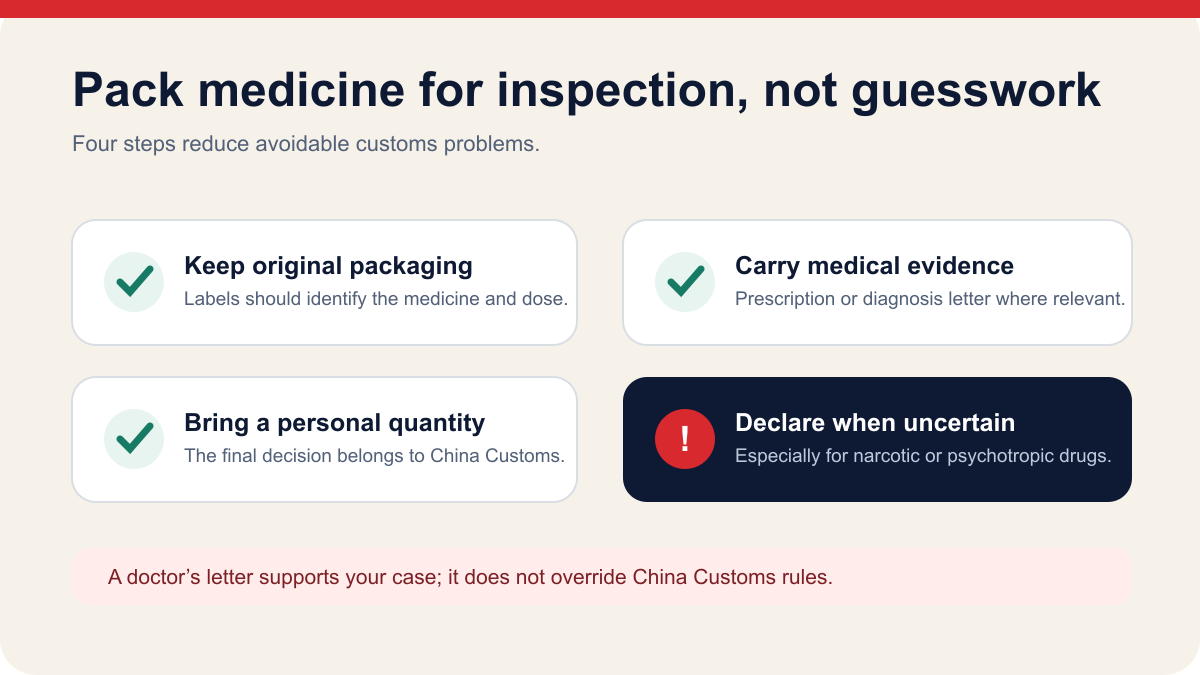
Check each medicine before departure
List every medicine you plan to carry, including routine daily medicines, and check whether each is controlled in China. Resolve any uncertainty before you travel.
Where practical, carry medicines in your hand luggage with their prescriptions and original packaging. Labelled packaging makes identification easier than an unlabelled divided pill box.
For a longer stay, ask your doctor and an official Chinese source about a lawful supply plan. Do not assume that a long prescription overrides category-specific quantity limits at the border.
- List and check every medicine before you travel.
- Carry medicines in original packaging with the prescription.
- For a long stay, confirm a lawful supply plan before departure.
If Customs asks about your medicine
Explain calmly that the medicine is for your treatment and show the prescription and packaging. Customs will check whether the item and quantity meet personal-use requirements.
Let the officer inspect what you declared. Do not argue, conceal an item or discard medicine you were asked about; concealment can raise concerns about a violation.
If a medicine is detained or refused entry, ask for the stated basis and any written record available. Contact your country's consulate if the matter becomes a legal or welfare problem.
Before leaving the checkpoint, write down the medicine name and the officer's stated reason. Keep an accurate note to use when following up with Customs, a consulate or your doctor.
For a daily medicine, discuss missed-dose and replacement planning with your clinician before travel. Airline cabin and checked-baggage rules, temperature requirements and Customs rules are separate questions, so verify all three for the specific product.
Continue the setup
Tasks connected to this guide
When Plan A fails
Fallbacks and safety checks
- If you are unsure about a medicine, check with China Customs or a consulate before travelling.
- If a medicine contains a controlled substance, check its Chinese classification and carry the diagnosis certificate, identification and quantity required for that category.
- If you are stopped, show the prescription and packaging calmly; do not hide or discard anything.
Common questions
Frequently asked questions
Can I bring my prescription medicine into China?
Small quantities of non-controlled medicine may be carried for reasonable personal use under Customs supervision. A controlled medicine may still be permitted for medical treatment, but narcotic drugs and Category I psychotropic medicines require a medical diagnosis certificate and identity document and are limited to the maximum quantity on one prescription; Customs makes the final decision.
What medicines are restricted in China?
Medicines containing narcotic or psychotropic ingredients that are controlled in China are the main risk, even when they are routine prescriptions elsewhere. Confirm the status of any such medicine through an official source.
How much medicine can I bring?
For ordinary medicine, Customs assesses a reasonable personal-use quantity in light of the trip and supporting documents. Narcotic drugs and Category I psychotropic medicines are limited to the maximum quantity on one prescription; Category II psychotropic prescriptions may be extended where appropriate.
Do I need to declare my medicines?
Use the red-channel customs declaration for medicines that require it, such as larger quantities or those needing declaration. When in doubt, declare.
Can I bring ADHD medication such as methylphenidate into China?
China's 2025 medicinal psychotropic-drug list places methylphenidate in Category I. A traveler should verify the exact active ingredient and current rule before departure; the official traveler guidance requires a diagnosis certificate and identity document for Category I psychotropic medicine and limits the amount to the maximum quantity on one prescription, subject to Customs review.
Is this page medical or legal advice?
No. This is general guidance based on China Customs rules. Confirm any specific medicine through an official source before travel.
Evidence
Primary sources
Source list last checked: .