Hotels & accommodation
Source checkedTemporary Residence Registration in China for Visitors (2026)
Register a non-hotel stay within 24 hours using nationwide NIA online channels or in-person registration. Check host assistance and completion. Reviewed 22 September 2026.
The short answer
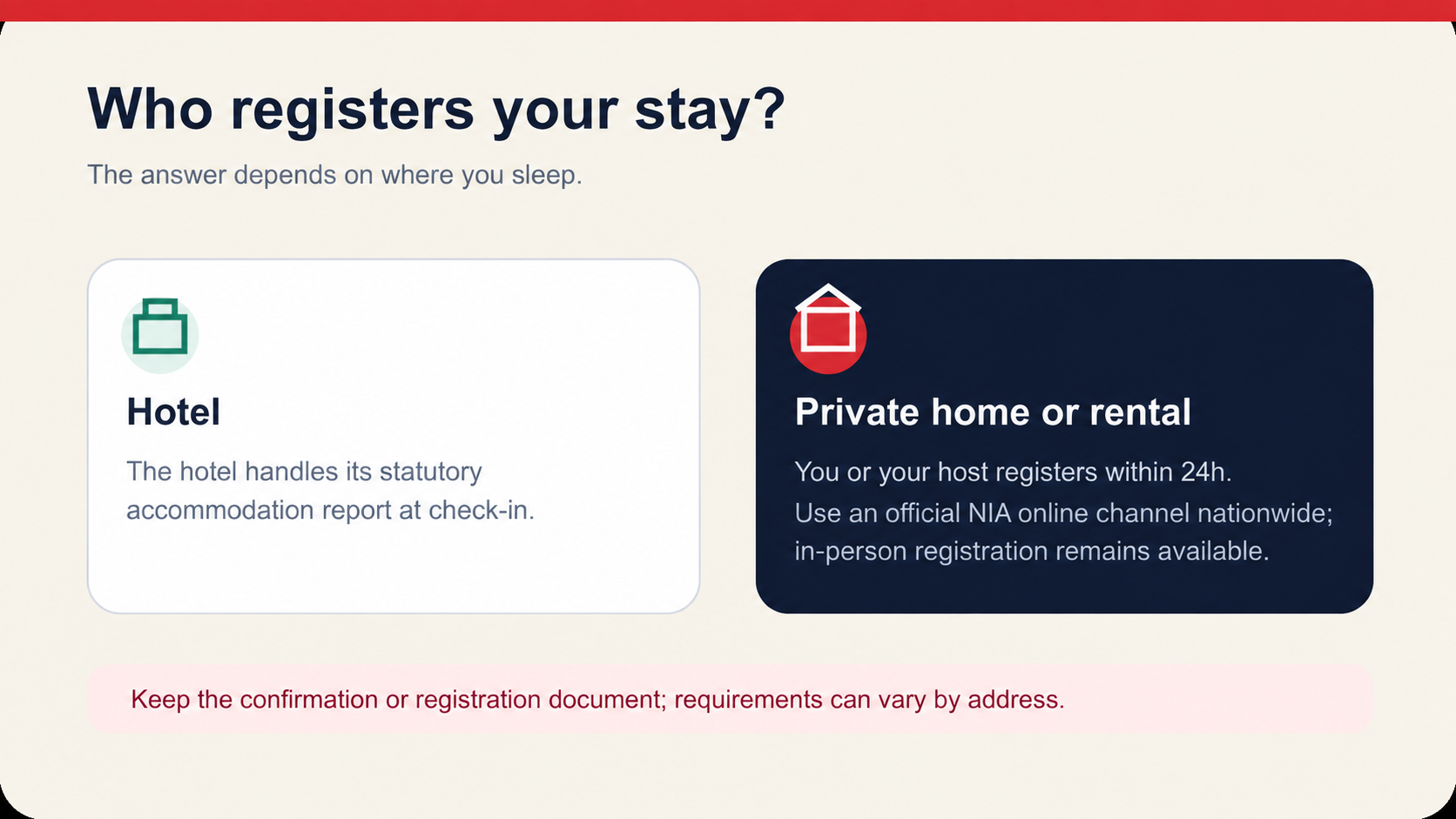
Hotels report guest accommodation at check-in. For a non-hotel stay, you or your host must register within 24 hours. NIA online registration is nationwide from 21 September 2026; in-person registration remains available.
Jump to a section
Step by step
What to do
- 01
Know which stays need registration
A hotel registers your accommodation information as part of check-in. At a friend's home, private rental or other non-hotel address, you or your host must register within 24 hours of arrival.
- 02
Use an official online channel nationwide
Use the NIA website, NIA 12367 App, or WeChat or Alipay mini program. Arrange host assistance for the first registration, complete identity verification, and follow Accommodation Registration under Foreigner Service.
- 03
Use in-person help if online registration fails
Call 12367 or visit the local police station or exit-entry service window for help. The 24-hour deadline still applies; an unfinished online submission is not a completed record.
- 04
Keep the confirmation with your passport
After completion, check Registration Record Inquiry in the NIA platform and save the record. For in-person registration, keep the confirmation provided by the official channel.
Register stays at a private address
If you stay at a friend's home, private rental, homestay or another non-hotel address, Chinese law requires registration within 24 hours of arrival. Failing to register can carry a penalty. Hotels complete their own registration at check-in.
Article 39 of the Exit and Entry Administration Law places responsibility on the foreign guest and the host, with either one required to complete registration with the local public-security organ within 24 hours of arrival. Article 76 provides for a warning and possible fine if this is not done.
A hotel has a statutory duty to register guests at check-in. For a private stay, agree with your host who will complete registration and keep the resulting record; a booking confirmation alone does not establish completion.
| Stay type | Who registers | What happens |
|---|---|---|
| Hotel or licensed guesthouse | The hotel, at check-in | Present the valid travel document requested at reception; the hotel reports the stay |
| A friend's or relative's home | You or your host, within 24 hours | Register online or at a police station |
| A private rental or homestay | You or the host, within 24 hours | Register online or at a police station |
| Return to an already-registered self-owned residence | No new registration under the stated NIA exception | The same residence must be owned by you or your spouse; check that the exception applies |
When the 24-hour period starts
The clock starts when you arrive at the residence, not when you land in the country. Within 24 hours of that arrival, either you or the person accommodating you must complete the registration.
This applies to the non-hotel residence where you are actually staying. The official rule does not state a short-stay exemption, so do not assume a one-night stay is outside it.
Arrange the first registration with your host, who knows the residence details. The NIA permits independent online registration if you have previously registered through its platform at that same residence, or if you stay in a self-owned residence.
Nationwide online registration
From 21 September 2026, the National Immigration Administration expanded online accommodation registration nationwide for foreigners staying outside hotels. It had previously been limited to the March seven-area pilot. Registration is still required within 24 hours.
Use the official NIA government-service website, the NIA 12367 App, or its WeChat or Alipay mini program. Complete account registration and identity verification, then follow Accommodation Registration under Foreigner Service. After completion, use Registration Record Inquiry to check the record and save it.
Online and in-person registration have the same legal effect. If you cannot finish online, contact 12367 or the local exit-entry service window or police station before the deadline. Check that your submission completed; nationwide availability does not guarantee every account or submission will work.
Who registers, and how
Either the foreigner or the host may complete the registration. The host can be a Chinese citizen or a foreigner. The host is generally expected to help with the first registration because they know the residence details.
You may register independently online after a previous NIA-platform registration at that same residence, or for a self-owned residence. The NIA defines a self-owned residence as one owned by you or your spouse in China.
Be ready with the residence information and the identity and travel-document details requested by the official channel. Exact fields can differ by channel; do not send passport images or documents to an unofficial helper.
- Use an official NIA online channel nationwide; arrange host assistance for the first registration.
- If online registration fails, call 12367 or visit the local police station or exit-entry service window; do not assume an unfinished submission meets the deadline.
- Use only official channels; never send a passport image to an unofficial helper.
When you do not need to re-register
If already registered after arrival, returning to the same self-owned residence after domestic or overseas travel does not require re-registration. The residence must be owned by you or your spouse in China.
A residence-permit or permanent-residence-permit holder who has already registered and returns to the same habitual residence during the validity of that same permit also falls within the NIA exception. Habitual residence means a place in China where the person lives or plans to live for more than 180 days. This is not a blanket exception for repeat tourist stays.
Hotels continue to register guests at check-in. You do not need a separate police-station visit for the same hotel stay; arrange registration yourself or with your host for a non-hotel stay where required.
Practical tips for rentals and homestays
If you book a private rental through an app, confirm with the host who will handle the registration and when. Some hosts complete the official process for the guest; others expect you to do it together within the first day. Ask for the resulting confirmation rather than assuming the booking platform completed it.
Keep the host's contact details, full residence address in Chinese and completed registration record. Chinese address text helps the police station or NIA platform identify the residence without translation.
A homestay that tells you to skip registration does not remove the legal duty. Ask the host to assist, use an available official online channel, or contact the local public-security organ or 12367 for the correct local process.
Register even a one-night stay. The rule has no short-stay exemption, so complete it on the day you arrive.
- Confirm with the host who handles registration and when.
- Keep the host contact and the residence address in Chinese characters.
- Register even a one-night stay; there is no short-stay exemption.
What happens if you forget
Article 76 provides for a warning and a possible fine if a required non-hotel registration is not completed. Do not assume a booking, a saved draft or an attempted submission is a completed registration.
If you realize you missed the 24-hour window, contact the official channel or local public-security organ promptly and follow its instructions. This guide cannot predict whether a warning or fine will be imposed.
Keep the completed registration record available with your travel documents. It helps you show what was registered, but does not replace your passport or any required entry or residence permission.
Continue the setup
Tasks connected to this guide
When Plan A fails
Fallbacks and safety checks
- If you missed the 24-hour window, register as soon as you can rather than waiting.
- If you cannot finish online registration, call 12367 or seek in-person help at the local police station or exit-entry service window before the deadline.
- Never send a passport image to an unofficial helper; use only the NIA channels or a police station.
- If you return to a residence already covered by the NIA's stated re-registration exception, keep the earlier record available and check that the exception fits your situation.
Common questions
Frequently asked questions
Do I need to register my stay in China?
Hotels register guests at check-in. For a non-hotel stay, such as a friend's home, private rental or homestay, Article 39 of the Exit and Entry Administration Law requires you or your host to register within 24 hours of arrival.
What happens if I do not register a non-hotel stay?
Article 76 of the Exit and Entry Administration Law provides for a warning and possibly a fine for failing to register. Register as soon as you can if you miss the window.
Is online accommodation registration available nationwide?
Yes. The NIA nationwide rollout took effect on 21 September 2026, replacing the seven-area pilot. Use an official channel and confirm the completed registration record; this does not guarantee every individual submission succeeds.
How do I register online?
Use the official NIA website, NIA 12367 App, or WeChat or Alipay mini program. Complete registration and identity verification, then follow Accommodation Registration under Foreigner Service. Arrange host assistance for the first registration and check Registration Record Inquiry after completion.
Can I register at a police station instead?
Yes. In-person registration remains available at the local public-security authority. Call 12367 or visit a local police station or exit-entry service window if you need help or cannot complete the online process.
Do I need to re-register when I return home?
The NIA says re-registration is not required when you return to the same already-registered self-owned residence after travel, or when a valid residence-permit or permanent-residence-permit holder returns to the same habitual residence. Those are specific exceptions, not a general exemption for every return stay.
Evidence
Primary sources
Source list last checked: .