Entry & visas
Source checkedChina Visa Requirements for Visitors
Check which China visa you need, what documents to prepare, fees and processing times. Source-checked, last checked 2026.
The short answer
Check the rules for your passport, purpose, route and length of stay before applying. For sightseeing, you will usually need an L tourist visa if no current waiver covers the trip. Fees, processing times and document requirements depend on the embassy, consulate or visa centre handling your application.
Visa-free checker
Get the answer for your trip first
Check the passport, purpose, entry date and stay you will actually use. If a visa is required, continue only through the official application system and the Chinese mission responsible for your location.
Application requirements vary by location. Find the responsible Chinese embassy or consulate
Jump to a section
Step by step
What to do
- 01
Check whether you need a visa at all
Use a current embassy or National Immigration Administration page for your passport and route. Do not rely on a search snippet or an undated country list.
- 02
Confirm the visa type for your trip
Tourism usually uses an L visa and commercial trade uses an M visa. Work, study and journalism require their own categories and may need prior approvals.
- 03
Collect the documents for an L tourist visa
Prepare the online application, passport, photo and the travel or invitation material required by the mission that will receive your case.
- 04
Apply and allow enough processing time
Allow time for online review, submission, any individual checks, holidays and passport return. The shortest published processing time will not cover all of these.
- 05
Save the fee notice and receipt
Fees vary by nationality, location, entries and service speed. Keep the dated official schedule used and the final receipt.
Check your passport and trip
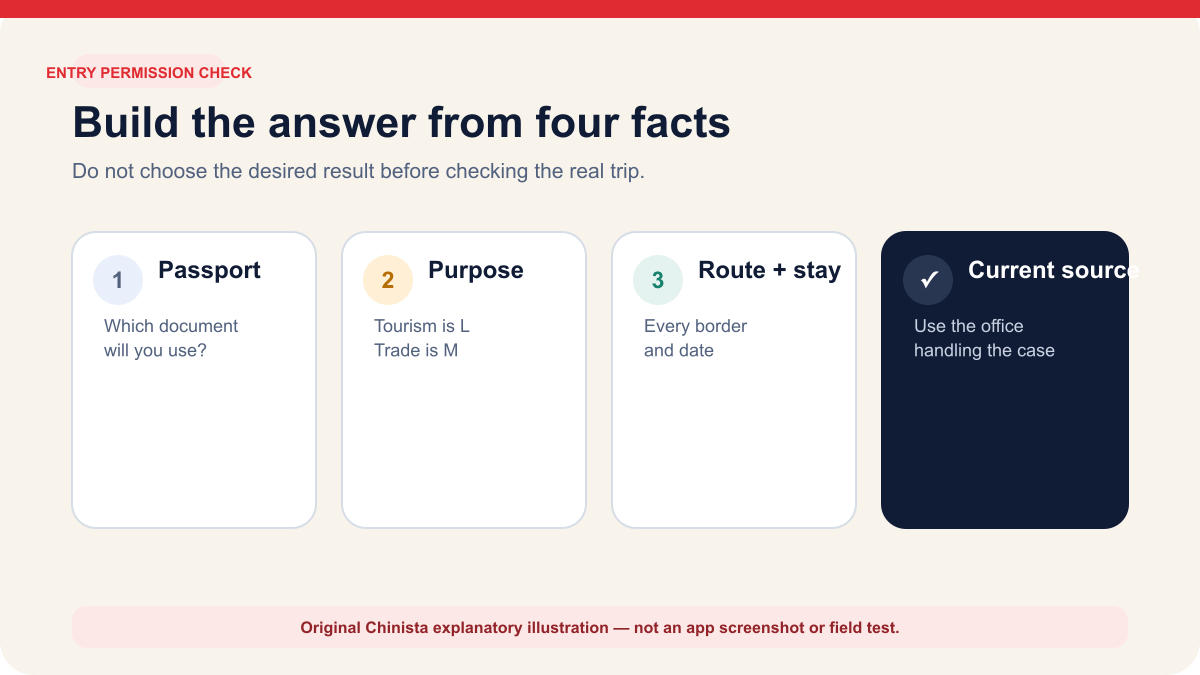
Your entry permission must cover your passport, purpose, route and length of stay. If a visa-free arrangement covers all four, you may not need a visa. Otherwise, ordinary sightseeing trips usually require an L tourist visa. Business, employment, study and journalism may need a different category even for a short stay.
Check the rules for the passport you will present at the border. Residence in another country, a second passport, a valid foreign visa or a familiar airline route does not automatically change those rules. Write down who is traveling, why, where from, how long they will stay and where they will go next. The application, tickets and accommodation records should agree with that plan.
China has expanded unilateral visa-free entry and 240-hour visa-free transit. Both have conditions, and their country lists can change. Check the current embassy, consulate or National Immigration Administration guidance close to departure; an old country list or search snippet may no longer be accurate.
| Question | Why it matters | Evidence to check |
|---|---|---|
| Which passport? | Visa waivers and fees are nationality-specific | Current official country rule and passport validity |
| What purpose? | Tourism, trade, work and study use different categories | Official visa-category description |
| What route? | Transit requires a genuine onward destination | Confirmed arrival and onward itinerary |
| How long? | Waivers, visa validity and permitted stay are different clocks | Issued visa or current waiver conditions |
Do you need a visa?
Check visa-free entry before starting an application. The Ministry of Foreign Affairs' current visa-waiver FAQ lists eligible ordinary-passport nationalities, permitted purposes and stay conditions. Most participating countries have explicit policy end dates, so check that the rule will still apply when you travel.
A visa-free nationality is only one part of the test. The passport type, intended activity and planned stay must fit. Work, study, news coverage and similar purposes remain outside the ordinary visitor waiver. Border inspection can examine whether the documents support the stated purpose, so carry accommodation and travel records even when no advance visa application is required.
If the ordinary waiver does not cover your trip, check whether a specific exemption applies to your route. The 240-hour transit policy requires an onward journey; a round trip does not qualify. Hong Kong and Macao have separate immigration systems, so include each border crossing in the itinerary. If eligibility remains unclear, contact the responsible Chinese mission or the National Immigration Service Hotline 12367 before buying an inflexible ticket.
Visa types: which one applies
The L visa is for tourism; the M visa is for commercial and trade activity. For negotiations, a trade fair or another commercial activity, check the M requirements even if the L checklist looks shorter. Work, study, family reunion and journalism have their own categories and supporting approvals.
Choose the category that matches the main purpose of the trip, then read the current guide from the mission receiving your application. The Ministry of Foreign Affairs consular service page identifies L applicants as visitors entering for tourism and M applicants as visitors entering for commercial trade. It also allows officials to request additional material in individual cases, so completing a general checklist does not guarantee approval.
Do not confuse entry validity, number of entries and duration of stay. A visa can be valid for a period, permit one or more entries and set a different maximum stay for each entry. Read all three fields when the passport is returned. If the issued category, name, passport number, entries or dates appear wrong, contact the issuing office before departure rather than hoping airline or border staff can correct it.
- L: tourism
- M: commercial and trade activity
- Z: employment, normally with prior work authorization
- X1 or X2: long-term or short-term study
- Q or S categories: qualifying family or private matters
- J categories: journalism, with the required prior process
The documents for a tourist (L) visa
The Ministry of Foreign Affairs' current L-visa guidance says applicants should complete the online application and submit the passport and photo, evidence of lawful stay or residence where relevant, and previous Chinese passport or visa records when applicable. For tourism, it also lists round-trip flight and hotel itinerary material, or an invitation letter containing the required personal, itinerary and inviter details. The responsible mission's current checklist controls the exact format.
Check your passport's expiry date and blank pages early. The Chicago consulate's current FAQ says it cannot accept a passport with less than six months' validity or fewer than two blank visa pages. Use that as a planning minimum, but read your own mission's instructions if applying outside its district. Requirements for photos, uploads, signatures, old passports, proof of residence and family-history records can vary by office and case.
A current notice from Chinese visa authorities overseas exempts applicants for short-term visas with stays of no more than 180 days from fingerprint collection through 31 December 2026. Applicants for D, J1, Q1, S1, X1 and Z visas still follow the fingerprint procedure because those categories lead to residence-permit applications after entry. The exemption is time-limited and does not remove the online application, passport submission or case-specific document review.
Some missions have simplified routine evidence for particular applicants, while the MFA's general guidance still lists travel or invitation material. Follow the checklist for the office processing your application. Keep the online form, passport details and bookings consistent with your real plans; a reservation made only to fill a form can undermine the purpose you have stated.
- Original passport with the validity and blank pages required by the receiving office
- Completed online application and a compliant recent photo
- Fingerprint collection only when the current exemption or visa category does not remove it
- Proof of lawful stay or residence where the mission requests it
- Previous Chinese passport or visa material when applicable
- Flight and accommodation records, or a qualifying invitation letter, under the current local checklist
- Any additional document requested during individual review
Visa fees and other charges
There is no reliable worldwide flat price for a China visa. The amount can depend on nationality, number of entries, service speed, application location and whether a visa centre adds a separate service charge. Use the live fee notice of the embassy, consulate or visa centre responsible for the application; a third-party table may show the wrong nationality or omit service fees.
Official notices extend reduced fee schedules in some jurisdictions through 31 December 2026. The amounts vary: the Chicago consulate lists its United States fees in US dollars, while the Chinese Embassy in Thailand publishes a different table in baht that expressly excludes the visa-centre service fee. Check both the location and validity date of any fee quoted.
Save the fee notice used, the application order and the receipt. Before selecting express or urgent service, confirm that the service is available for the case and understand that faster handling does not guarantee approval. If the application is refused or the planned entry changes, refund rules come from the processing office rather than the traveler's unused booking.
| Cost | Who controls it | What to save |
|---|---|---|
| Visa application fee | Embassy or consulate schedule, often nationality-specific | Dated official fee notice |
| Visa-centre service fee | Local application centre | Checkout or appointment fee page |
| Express or urgent surcharge | Receiving office and case eligibility | Service choice and receipt |
| Courier or agency charge | Optional provider | Written scope and refund terms |
Allow time for review and passport processing
Allow time for both online review and processing after passport submission. The Visa for China FAQ checked on 22 September 2026 says online review commonly takes two to four working days or longer, with no guaranteed completion time. After approval and in-person submission, ordinary collection is described as the fourth working day. Faster paid services may be offered, but the page warns that cases can take longer.
The Chicago consulate's current FAQ lists four working days for ordinary processing and three working days for urgent cases after submission. Some applications take longer. These times apply to that office; check the schedule where you will apply and allow for holidays, incomplete documents, extra review, interviews and delivery.
Apply with enough margin before paying for non-refundable travel. The Visa for China FAQ recommends submitting roughly one month before entry and generally not earlier than three months because visa validity can make an application too early as well as too late. Check the responsible office's current advice for the actual category, then keep tickets and accommodation flexible until the passport and issued visa are back in hand.
Visa-free entry and 240-hour transit
An ordinary visa waiver lets eligible passport holders enter for specified short visits within its stay limit. The 240-hour transit policy applies to eligible travelers passing through China to a third country or region. It has separate requirements for the route, onward ticket, entry port and area in which you may travel.
The NIA announcement effective 20 August 2026 states that the 240-hour program covers nationals of 57 countries entering through 65 designated ports. It requires an ordinary passport with at least three months' validity and a confirmed onward ticket to a third country or region within the permitted period. The official page, not this summary, controls the current nationality list and permitted areas.
Before relying on the ten-day transit allowance, check your passport, first mainland port, onward destination, ticket date and every city you plan to visit. Transit is not a tourist visa, and border inspection decides whether to grant temporary entry. If your route does not fit or your plans cannot accommodate a refusal, apply for the visa category that matches the trip.
Continue the setup
Tasks connected to this guide
When Plan A fails
Fallbacks and safety checks
- If the passport, purpose or route does not clearly fit a waiver, apply for the appropriate visa instead of asking an airline counter to resolve the ambiguity.
- If the receiving office requests extra material, follow that case-specific request; a general checklist cannot overrule the consular review.
- If processing runs beyond the published ordinary time, use the order status and official contact route before making a second application or paying an unofficial agent.
- If the visa is refused or delayed, keep flights and accommodation flexible and read the provider's immigration-refusal terms before accepting the loss.
- If the issued visa contains an identity, category, entries or date error, contact the issuing office before travel.
Common questions
Frequently asked questions
Do I need a visa to enter China?
Your nationality, passport type, route, purpose and stay length decide the answer. China has expanded ordinary visa-free entry and transit programs, but their conditions and country lists can change. Confirm the current policy for your passport before booking; if no exemption fits, obtain the visa that matches the trip.
What are the requirements for a China tourist visa?
You typically need the online application, a passport and compliant photo, plus travel bookings or a qualifying invitation under the current L-visa guidance. Passport validity, blank-page and supporting-document rules can vary by mission and individual case, so use the exact list published by the office receiving your application.
How much does a China visa cost?
Fees depend on nationality, visa type, entries, application location and service speed. Some jurisdictions have extended reduced fees through 2026. Use the current schedule from the embassy, consulate or visa centre handling your application.
How long does it take to get a China tourist visa?
Official channels commonly publish a few working days for online review and several working days after submission, while warning that individual cases can take longer. Apply before booking non-refundable travel and confirm the current timeline with the office handling your application.
Can I enter China visa-free?
Some ordinary-passport nationalities qualify for visa-free entry, and a separate visa-free transit policy may fit certain onward routes. The country lists, permitted purposes and end dates can change, so check the current official policy for your nationality and itinerary before assuming you can enter without a visa.
What is the 240-hour visa-free transit?
Eligible travelers from certain countries can stay in designated areas for up to 240 hours while transiting to a third country or region. This is a transit exemption, not a tourist visa. Check the current nationality list, entry port, onward-ticket requirements and permitted area.
Evidence
Primary sources
Source list last checked: .
- National Immigration Administration — current 240-hour visa-free transit policy (57 countries and 65 ports)
- National Immigration Administration — transit conditions appendix: document validity and stay calculation (3 November 2025)
- Ministry of Foreign Affairs consular service — tourist L-visa purpose and required materials, updated 6 May 2026
- Ministry of Foreign Affairs consular service — current Visa Application Instructions
- Ministry of Foreign Affairs consular service — unilateral visa-waiver FAQ, updated 21 July 2026
- Chinese Consulate-General in Chicago — visa application FAQ page checked 19 August 2026
- Chinese Consulate-General in Chicago — reduced US visa fee schedule through 31 December 2026
- Chinese Embassy in Thailand — local reduced visa fee schedule through 31 December 2026
- Visa for China — online review and submission processing-time FAQ
- Chinese Consulate-General in Sydney — fingerprint exemption for short-term visas through 31 December 2026