Safety & emergencies
Source checkedChina Emergency Numbers and Offline Contacts
Know the numbers to call before you need them, and save a bilingual help card you can show when you cannot describe the emergency in Chinese.
The short answer
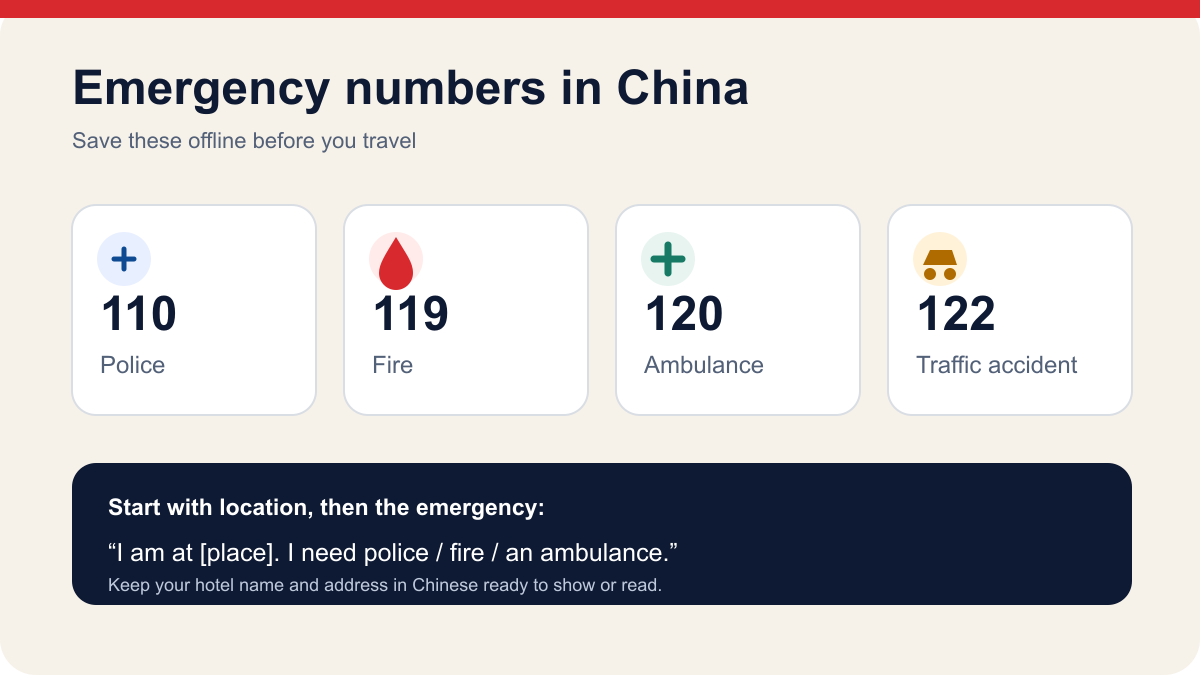
The emergency numbers to know are 110 for police, 120 for an ambulance, 119 for fire and 122 for a traffic accident. Save them offline with a bilingual help card and your location, so you can ask someone nearby to call if you cannot speak Chinese.
Jump to a section
Step by step
What to do
- 01
Save the four core numbers offline
Save 110 (police), 120 (ambulance), 119 (fire) and 122 (traffic accident) on paper, a lock-screen note or a contact card you can open without data. Confirm how you will make voice calls before the trip: a data-only travel eSIM or inactive SIM may not support them.
- 02
Save a bilingual emergency help card
Use the China Rescue Pack linked below to choose the service and add your location. Save the card before travel and show it to someone who can call on your behalf; you do not need to write or pronounce Chinese yourself.
- 03
Know the non-emergency channels
12110 is a supplementary police SMS channel when speaking is unsafe or impossible, but the destination format can vary by region; some locations require 12110 plus the final three digits of the local area code. Use 110 by voice when it is safe and possible. Keep 12345 for non-emergency government services, 12306 for rail and 95128 for taxis where available.
- 04
Record your exact location
Save your hotel name and address in Chinese characters, plus the nearest landmark. Give the operator or first responder your location as well as a description of the problem.
Save these four emergency numbers
China uses separate emergency numbers: 110 for police, 120 for an ambulance, 119 for fire and 122 for a traffic accident. The China Daily government portal and provincial government English pages list these numbers.
Save all four before travel in a written note, lock-screen note or contact card you can read without data or an app. Keep the table below as a reference.
| Number | Service | When to call it |
|---|---|---|
| 110 | Police | Crime, a threat to your safety, or when you need police assistance |
| 120 | Ambulance | A medical emergency that needs transport to a hospital |
| 119 | Fire | A fire or an emergency rescue situation |
| 122 | Traffic accident | A road accident, in addition to police |
Check that you can make a voice call
Do not assume that a data-only travel eSIM can place a voice call. Some travel plans provide mobile data but no telephone number or outbound calling, and an inactive or incompatible SIM may not connect the way you expect.
Before travel, confirm that at least one phone in your group has outbound voice service in China. Test it by calling a normal contact, your carrier or your hotel. Never make a test call to 110, 120, 119 or 122.
Keep the phone charged and carry a small power bank so you can make a call when needed.
- Save 110, 120, 119 and 122 on paper or a lock-screen note.
- Keep the phone charged and a power bank available.
- Confirm a real voice-calling path instead of relying on a data-only eSIM.
When you cannot speak Chinese
Do not assume the operator will be able to continue in English. Keep a written help card that you can show to someone nearby; you do not need to pronounce Chinese characters to use it.
For an ambulance, show: 请帮我叫救护车,拨打120。我的位置是:____ ('Please call an ambulance on 120. My location is: ____'). Fill in your current location; use the hotel address only if you are there.
Use the China Rescue Pack below to choose a police, ambulance or fire card, enter a location and save the bilingual card as an image, text or printout before travel. It does not call emergency services or translate a medical history. In an emergency, call or seek nearby help immediately rather than spending time completing the tool.
SMS and non-emergency channels
12110 is a supplementary police SMS channel for situations where speaking is unsafe or impossible, including a hearing or speech difficulty. Public-security instructions vary by place: some regions tell users to address the message to 12110 plus the final three digits of the local telephone area code. Confirm the local format when possible; use 110 by voice when it is safe and possible.
12345 is the general non-emergency government service hotline. Use it for administrative or service problems that are not life-threatening, such as a complaint or a question about a public service. It is not a substitute for 110, 120 or 119 in a real emergency.
For transport-specific problems, 12306 is the national railway customer service line and 95128 is the taxi hotline available in many cities. These resolve booking and transport issues rather than emergencies.
| Number | Service | Use |
|---|---|---|
| 12110 | Police SMS | Supplementary text channel; local addressing format may vary |
| 12345 | Government service hotline | Non-emergency help, complaints and administrative questions |
| 12306 | Railway customer service | Train booking and ticketing problems |
| 95128 | Taxi hotline | Book or find a taxi by phone where available |
Record your exact location
Save your hotel's name and full address in Chinese, with a nearby landmark or intersection. An operator or responder needs your exact location, so keep details you can read out or show to a helper.
If you are in transit, note the station name or the road you are on in Chinese. A screenshot of your position on a map in Chinese is a practical way to communicate location when you cannot pronounce it.
Keep this location information with your emergency numbers and call script, so everything a helper needs is in one place.
Ask someone nearby to help
When you are ill, injured or overwhelmed, you do not have to handle the call alone. Hotel staff know the property address and may be able to call in Chinese, but English ability and the help available vary by property and shift.
Before you need help, note the hotel front desk number in your phone and keep it beside the emergency numbers. If you are staying in a private rental, identify the nearest hotel or the building management as your first local contact.
A companion who does not speak Chinese can show the bilingual card to staff, point to the service you need and provide your current location. Ask them to help with the call if you are too unwell to manage it.
- Save the hotel front desk number next to the emergency numbers.
- Show the written script to a clerk or passerby if you cannot speak.
- Let a helper note the hospital, time and what was said for your insurance or embassy.
When help arrives
If they are immediately accessible, take your passport, medicine list and insurance details. Do not delay an emergency call or urgent departure while searching for paperwork.
If you are with a companion or hotel staff, ask them to note the hospital name and the time of arrival. This helps if you need to contact your insurance or your embassy later.
For problems that are not emergencies, use the service numbers listed above so emergency lines remain available for urgent calls.
Continue the setup
Tasks connected to this guide
When Plan A fails
Fallbacks and safety checks
- If you cannot describe the emergency in Chinese, show the bilingual help card and your current location to a hotel clerk or nearby person who can call on your behalf.
- If speaking is unsafe or impossible, ask a local helper to confirm the correct 12110 SMS format for that city; use 110 by voice whenever it is safe and possible.
- If 120 or 110 is not answering, ask the hotel front desk, who can arrange transport, a pharmacy run or contact with authorities.
- Never delay calling an emergency number because you are unsure of the language; the number connects you to help first.
Common questions
Frequently asked questions
What is the emergency number in China?
China uses separate emergency numbers: 110 for police, 120 for ambulance, 119 for fire and 122 for traffic accidents. These are listed on the China Daily government portal and provincial government English pages.
Can I call 120 or 110 without a Chinese SIM card?
Do not plan around that assumption. A data-only travel eSIM may not support voice calls, and an inactive or incompatible phone may not connect as expected. Before travel, confirm outbound voice service with your carrier or by calling a normal contact such as your hotel; never make a test call to an emergency number.
What should I do if I cannot speak Chinese during an emergency?
Show a bilingual emergency help card and your current location to a hotel clerk or nearby person who can call on your behalf. The China Rescue Pack lets you save a card before travel without writing Chinese yourself. Do not delay calling or seeking help to complete the tool.
What is 12345 used for in China?
12345 is the general non-emergency government service hotline. Use it for administrative or service problems that are not life-threatening, rather than calling an emergency number.
Is 999 also an ambulance number in China?
120 is the nationwide ambulance number. Some areas also operate 999 as a Red Cross emergency service, but 120 is the standard number to call for an ambulance.
What number should I call for a traffic accident?
Call 122 for a traffic accident and 110 for police. If there are injuries, call 120 for an ambulance as well.
Evidence
Primary sources
Source list last checked: .