Health & emergencies
Source checkedMedical Care in China for Travelers: Hospitals, 120 & Payment
Choose emergency or outpatient care, prepare a bilingual medical card, confirm hospital language and insurance, and preserve records for a claim.
The short answer
Call 120 for a medical emergency and state the exact Chinese location. For stable care, confirm the hospital department, opening time, language help and payment before traveling. Bring a bilingual medicine and allergy card, but do not delay urgent treatment for documents. Travel insurance is not automatically cashless: direct billing exists only when the specific insurer, policy and facility have an arrangement.
Jump to a section
Step by step
What to do
- 01
Prepare a bilingual medical and location card
Record conditions, allergies, generic medicine names and doses, emergency contact, insurer and the accommodation's Chinese address. Keep it offline and with a companion.
- 02
Choose the right level of care
Call 120 for a medical emergency. For serious stable or routine care, use the appropriate hospital emergency department, outpatient clinic or insurer-directed facility.
- 03
Confirm the facility before a non-emergency visit
Ask whether the facility treats your condition, whether the department is open, what language help is available and how payment or insurance will work.
- 04
Explain the symptoms and check treatment instructions
State the main problem, onset, severity, allergies and medicines. Confirm the generic name and dose of treatment and use professional interpretation for complex consent where available.
- 05
Collect records before leaving
Keep diagnosis, discharge instructions, prescriptions, tests, itemized bills and receipts. Follow warning signs and return or call 120 if symptoms worsen.
Choose emergency, urgent or routine care
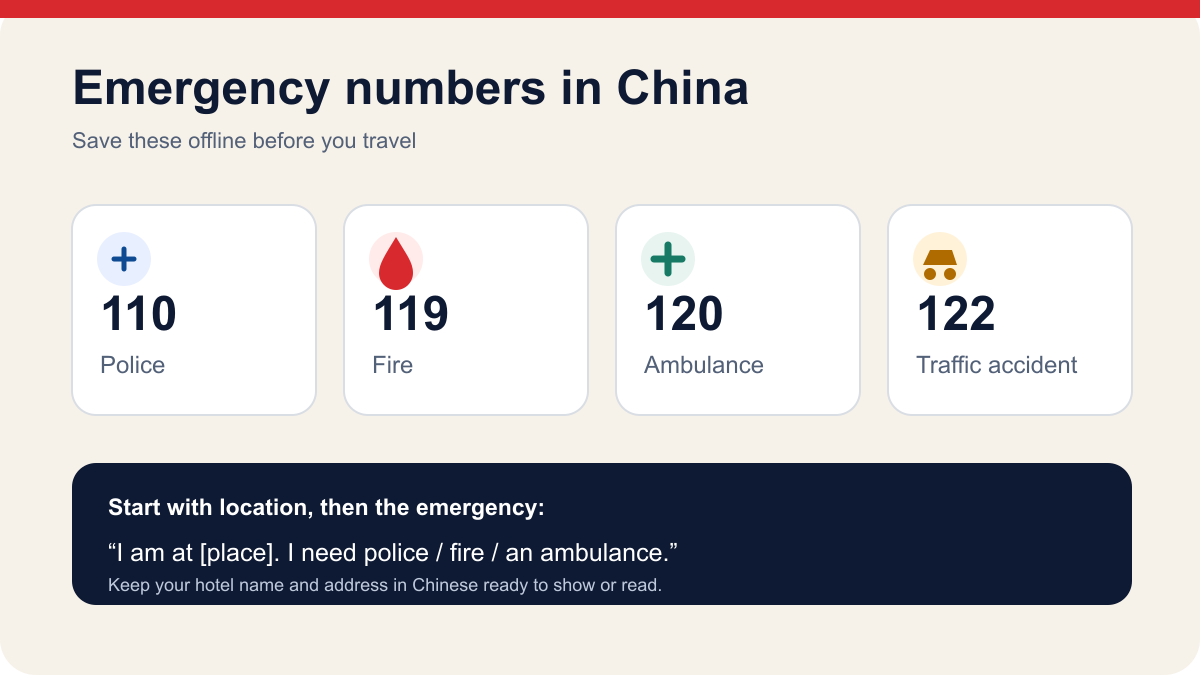
Call 120 for a medical emergency that needs pre-hospital help or ambulance transport. Beijing and Shanghai government health pages identify 120 as the medical-emergency number, and almost all general hospitals have emergency departments. If you cannot place a voice call, ask hotel staff, station staff or a nearby person to call and give the exact Chinese location.
For a serious but stable problem, go to a hospital emergency department or a clinic recommended by your insurer. Routine illnesses may be handled by an outpatient department, which may require registration or an appointment. International medical departments can offer foreign-language help; call to confirm hours, specialties, language support and prices, since services may not be available around the clock.
Get urgent care without waiting to compare prices or translate every form. Bring your passport, medicine and allergy list, insurance details and payment methods if they are immediately available. Call first if a delay would be dangerous. This guide covers arrangements for care; a clinician or emergency service must decide diagnosis and treatment.
| Situation | First action | Preparation |
|---|---|---|
| Life-threatening or rapidly worsening | Call 120 and state the exact location | Do not delay for paperwork |
| Serious but stable | Hospital emergency department or insurer-directed facility | Passport, medicine list, payment and insurance contact |
| Routine illness or follow-up | Outpatient clinic or international department | Appointment, specialty, language and price confirmation |
| Medication question | Qualified clinician or licensed pharmacy | Generic name, dose, prescription and medical history |
Prepare a bilingual medical card before travel
Prepare a card in English and simple Chinese with your name, date of birth, nationality, emergency contact, insurer, policy number, major conditions, allergies and current medicines. Include generic medicine names and doses alongside any brand names. Save it offline and give a copy to a companion. Check any app translation against the facts you supplied; it must not add medical information.
Include the first accommodation name, Chinese address and front-desk phone. An ambulance dispatcher needs location information before insurance information. If you have a time-critical condition, ask your clinician at home for a concise treatment summary and confirm how to carry the required medicine into China.
Keep at least one phone capable of voice calls. A travel eSIM may provide data only. Test by calling an ordinary number, never an emergency number. Save 120, the insurer assistance line, the accommodation desk and your country's consular emergency contact on paper as well as on the phone.
Find and confirm a suitable hospital
Use a current city-government health page, your insurer's network or the hospital's own website and phone. Beijing's Medical Guide for Foreigners lists international departments, language services and appointment options in Beijing. Hours, departments and insurer agreements can change. Unless it is an emergency, call before you travel.
Confirm that the facility handles your condition and urgency, the relevant department is open, the language help you need is available and your payment or insurance arrangements are accepted. A general hospital may be suitable even without an English website. In an emergency, use the nearest appropriate emergency department.
Save the hospital name and address in Chinese characters. Map pins can identify the wrong branch or entrance, especially for a campus with multiple gates. Ask the hospital or insurer to name the building and emergency entrance. At arrival, show the medical card and the exact symptom onset; do not let a translation shortcut replace important detail.
- Confirm specialty and opening hours directly.
- Save the Chinese hospital and entrance name.
- Ask what language assistance is available now, not in theory.
- Use the nearest appropriate emergency department when time matters.
Registration, deposits, payment and insurance
Bring the original passport when possible because the facility may need it to create the patient record. Expect separate steps for registration, consultation, tests, pharmacy and payment. Keep every invoice, itemized bill, test result and discharge note. Ask for the document name you need before leaving; recreating an itemized record after travel can be difficult.
Check with your insurer before assuming it will pay the hospital directly. Beijing's official guide says direct billing requires an agreement between the institution and insurer; otherwise you may need to pay out of pocket. Confirm your hospital, policy, authorization and deductible. An insurer's logo alone does not establish that your plan is covered.
Carry independent payment methods. Official payment guidance supports cash, mobile payment and eligible bank cards, but a particular hospital counter or foreign card can still fail. Ask for the estimated deposit and accepted methods before non-emergency care. Never transfer money to a personal QR code sent by an unknown 'hospital agent'; use the facility's cashier or official payment path.
Explain your symptoms and confirm the instructions
State the main problem first, then onset, severity, allergies, medicines and relevant conditions. If a companion translates, ask the clinician to confirm the final understanding back to you. Machine translation can assist with ordinary logistics, but a wrong unit, dose, symptom or allergy can cause harm. Ask for professional interpretation where available for consent or a complex decision.
Before taking medicine, confirm its generic name, dose, route, frequency and duration. Brands and packaging may differ from those at home. For a proposed test or procedure, ask its purpose, what follows and when results will be ready. Before leaving, make sure you understand the instructions, including any handwritten note you photograph.
At discharge, request a diagnosis or clinical summary, prescriptions, test results, imaging access, invoices and instructions for deterioration. Confirm whether you are fit to fly or continue to altitude, heat or strenuous travel if those are relevant. A travel itinerary should change when the medical advice requires it.
Follow-up care and insurance claims
Photograph and securely back up the records, then send only what the insurer or treating clinician needs. Follow the stated review date and warning signs. If symptoms worsen, return to the emergency department or call 120; do not wait for a claims representative to approve urgent care. Ask the accommodation to help arrange transport only when an ambulance is not medically required.
For an insurance claim, preserve the chronology, proof of payment, itemized bill, diagnosis, prescriptions and transport costs. Contact the insurer through the official app, card or website. A request to move the conversation to an unrelated messaging account, install remote-control software or share a one-time code is a fraud warning.
Your embassy or consulate may help with a missing person, death, detention, family notification or finding local resources. Consular staff cannot replace medical professionals, pay ordinary bills or guarantee hospital admission.
Continue the setup
Tasks connected to this guide
When Plan A fails
Fallbacks and safety checks
- If you cannot call 120, ask hotel, station or nearby staff to call and show the exact location in Chinese.
- If the preferred international department is closed, use the nearest appropriate emergency department when the problem is urgent.
- If direct billing is unavailable, use an independent payment method and preserve every record for the insurer.
- If a translation is unclear for a dose, allergy or consent decision, stop and request a qualified interpreter or clinician confirmation.
Common questions
Frequently asked questions
What is the ambulance number in China?
Call 120 for an ambulance and pre-hospital emergency medical service. Give the exact location in Chinese where possible and do not delay an urgent call while searching for insurance or passport documents.
Can foreign travelers use public hospitals in China?
Government visitor guidance says foreign nationals can seek care at medical institutions. Confirm the relevant department, hours and language support directly because those services vary by facility and time.
Will travel insurance pay a China hospital directly?
Only when the specific insurer or assistance company has a direct-billing arrangement with that institution and authorizes your case. Otherwise the patient may need to pay and claim later.
What should I bring to a hospital in China?
Bring the passport, bilingual condition and allergy list, generic medicine names and doses, insurance details and several payment methods when they are immediately available. Do not delay emergency care to collect them.
Do hospitals in China have English-speaking staff?
Some international departments and designated facilities provide foreign-language services, but availability varies by department and shift. Confirm it directly and keep a translation or local-helper fallback.
What medical records should I keep for insurance?
Keep the clinical summary or diagnosis, itemized bill, payment receipt, prescriptions, test results, discharge instructions and relevant transport costs, plus the insurer's case reference.
Evidence
Primary sources
Source list last checked: .