Money & payments
Source checkedHow to Pay in China as a Visitor (2026): Setup, Fees & Fallbacks
Set up mobile payments, understand international-card fees and keep card and cash fallbacks. Last checked 18 August 2026.
The short answer
Visitors can pay with Alipay or WeChat Pay using eligible international cards, use a physical card where accepted, and carry RMB cash as a backup. Set up a wallet before departure and keep more than one way to pay.
Jump to a section
Step by step
What to do
- 01
Add an international card to a supported wallet
Alipay and WeChat Pay support linking eligible international bank cards. Follow the identity and card prompts shown in the app; supported brands and fees can vary.
- 02
Run a low-value test when you arrive
Try a small purchase before you need to pay for a time-sensitive journey or booking. Keep the issuing bank's verification method accessible.
- 03
Carry a card and some RMB
Carry a physical bank card and some RMB as separate backups. Official guidance lists mobile payment, bank cards and cash as options for overseas visitors.
Prepare a wallet, card and cash before you leave
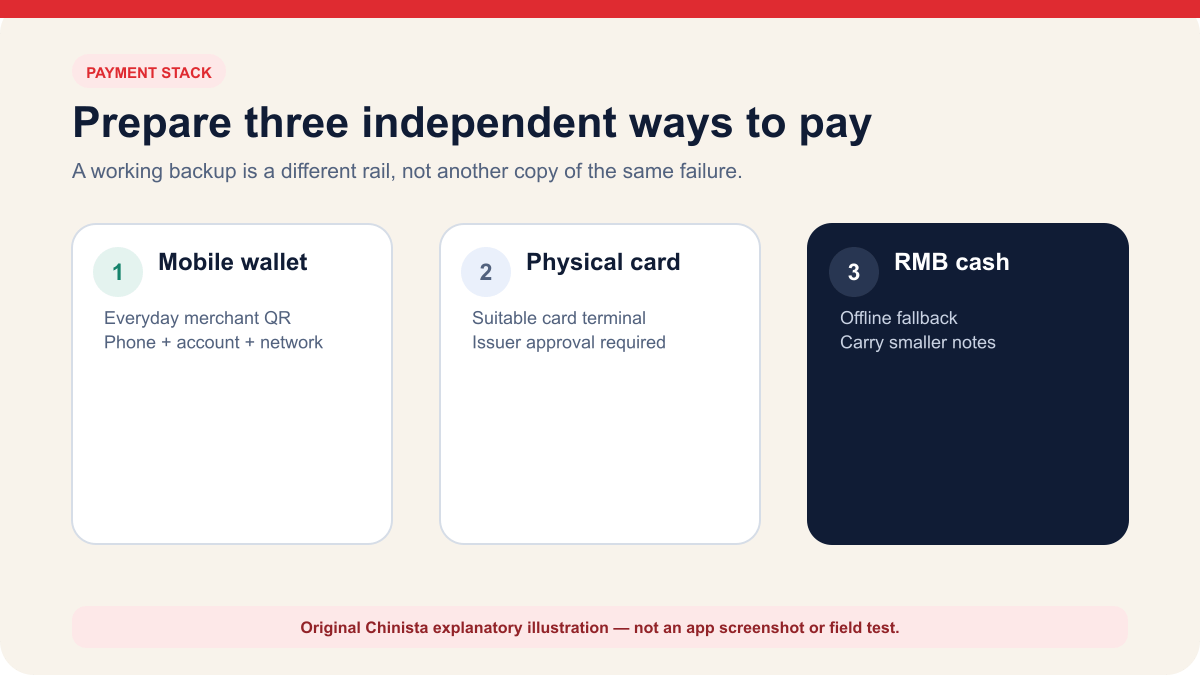
Prepare a mobile wallet for everyday QR payments, a physical international card for places with a card terminal, and access to RMB cash. Chinese government guidance for overseas visitors lists all three options. Keep them available independently: a wallet can fail while the card still works, and cash remains usable if the bank blocks the card.
Install both Alipay and WeChat before departure if your phone and app-store region allow it. Link a card, complete the identity checks requested on screen and find the payment code in each app. You can use one wallet regularly and keep the other as a backup. Bring at least two physical cards if possible, ideally from different banks. Cards on the same account may share fraud controls and fail together.
Cash deserves a place in the plan even when every test payment succeeds. It helps at a small counter with a broken terminal, during a network outage, or while a bank investigates a decline. Budget for a meal and a ride back to your accommodation using the costs of your actual route. Keep that backup separate, and balance what you carry against the risk of loss.
- Use one mobile wallet with a card you have already linked and verified as the primary route.
- Keep a second wallet or a card from another issuing bank as an independent backup.
- Store RMB cash separately from your main wallet and passport as the offline fallback.
| Observed failure | Possible cause | First official contact | Immediate travel fallback |
|---|---|---|---|
| Card will not bind | Wallet eligibility or issuer verification | Wallet support, then issuing bank | Different eligible card or cash |
| Wallet shows failed | Wallet, issuer or merchant transaction type | Read wallet status before contacting provider | Only after confirming no pending or successful payment and the merchant says unpaid |
| Bank shows pending | Issuer authorization and payment settlement | Issuing bank after checking wallet history | Do not repeat until status is clear |
| Merchant cannot take the linked card | Merchant acceptance or transaction category | Merchant checkout, not a stranger offering activation | Another accepted method, after confirming no unresolved payment for this order |
| Phone or data is unavailable | Device or network unavailable | Carrier or connectivity provider | Card or cash for a new purchase; resolve any earlier attempt first |
Set up Alipay and WeChat while support is easy to reach
Start at home on a connection you trust. Use the official listing in your app store, register with a phone number that can receive international SMS, and follow the current card-linking prompts. Government guidance says foreign or Chinese mobile numbers can be used for registration. It also lists major international card networks, while warning that supported brands, limits, and charges can differ by payment product. The screen in your account is the final practical check.
For Alipay, the usual path begins under Me and Bank Cards. For WeChat, look under Me, Services, Wallet, and Bank Cards. Menus move when apps update, so use those paths as orientation rather than a promise about every future version. Enter the cardholder name as your bank recognizes it. Complete any identity request with your own document, on your own device, and through the app. Never send a passport image to a stranger who offers to activate the wallet for you.
Linking a card does not guarantee every payment will work. The issuing bank must still authorize the purchase, and the wallet can restrict transaction types. International cards linked to Weixin Pay support consumer purchases; they do not create a Chinese bank balance or automatically enable transfers, cash-like payments or red packets. Check whether a QR code is for a merchant checkout or a personal transfer, since the two can look similar at a counter.
Keep your bank's app, authentication method, and international support number available. If the bank relies on SMS, make sure the registered number will still receive messages abroad. If it relies on push approval, open the banking app before travel and confirm you can sign in without a home-only network or a device you are leaving behind.
Read the fee and limit screen before you confirm
Official payment guidance raised the policy ceiling for overseas visitors using mobile payment platforms to USD 5,000 for one transaction and USD 50,000 in a year. Those figures are ceilings, not a promise that every account, card, merchant, or purchase will reach them. The wallet may show a lower limit, your bank may set its own daily or foreign-transaction limit, and a merchant category may not accept an international card through the wallet at all.
Tenpay's January 15, 2026 notice sets the standard Weixin Pay international-card service fee: a single purchase of RMB 200 or less is exempt; above RMB 200, the fee is 3 percent of the entire transaction amount, not just the portion above RMB 200, unless an applicable waiver reduces it. The checkout shows the fee before payment. If the purchase is refunded, Tenpay returns the service fee proportionally. Your card issuer may still charge its own foreign-transaction or exchange fees.
Tencent's May 27, 2026 announcement offers a temporary Weixin Pay waiver from May 27 through December 31, 2026 for users linking an international card for the first time. After the first purchase, eligible users receive 90 consecutive calendar days of the 3 percent service-fee waiver on up to RMB 1,000 of spending per day. This is a spending allowance, not RMB 1,000 in waived fees. Check the in-app eligibility, remaining allowance and end date before paying; the announcement does not explain how a purchase crossing the daily allowance is treated or whether the waiver continues into 2027. These Weixin Pay terms do not establish an Alipay promotion.
Check the final amount in RMB and the amount your card issuer later posts in your home currency. The wallet, card network, and issuing bank can play different roles in conversion. Your bank statement is the place to inspect the completed foreign-currency charge. If the checkout page shows an unexpected fee or the exchange result looks wrong, stop before confirming and use another method.
| Item | What the source supports | What still varies |
|---|---|---|
| Mobile-payment ceiling | Up to USD 5,000 per transaction and USD 50,000 per year for overseas visitors | Account status, provider controls, merchant type and issuer rules |
| Weixin Pay fee at RMB 200 or less | Standard international-card service fee waived | Issuer foreign-transaction and exchange charges may still apply |
| Weixin Pay standard fee above RMB 200 | 3 percent of the entire transaction amount, unless an applicable waiver reduces it | Read the fee shown at checkout and the temporary waiver below |
| Temporary first-card waiver | Campaign announced for May 27 to December 31, 2026: first-time international-card linking; after the first purchase, 90 consecutive calendar days with up to RMB 1,000 of spending per day exempt from the 3 percent fee | Confirm eligibility, remaining daily allowance and end date in the app; do not assume every payment qualifies |
| Refunded purchase | International-card service fee returned in proportion to the refund | Timing of the card credit depends on the payment chain |
Know which code is being scanned
There are two ordinary ways to make a QR payment. You can scan the merchant's code with your phone, review the amount, and approve it. The merchant can also scan the payment code generated inside your wallet. In both cases, read the merchant name and amount before you confirm. A sticker placed over another code, a name that does not match the business, or a request to send money as a personal transfer is a reason to pause.
At a staffed checkout, ask, ‘Can I pay with Alipay or WeChat?’ If the linked card is unavailable before any payment starts, ask for another accepted method. After an attempt, first check the wallet history, card account and merchant order. Use a fallback only when failure is clear, no pending or successful record remains, and the merchant confirms the order is unpaid. A timeout is not proof of failure.
Make your first test a modest purchase at an ordinary merchant. Check that the wallet loads, your card appears at checkout, the bank authentication works and the merchant receives confirmation. Allow time for this before you need to pay for a taxi departure, meet a train payment deadline or leave a hotel deposit.
Save the receipt or transaction record. If the result is pending, unknown or inconsistent, stop new attempts for that order and ask the merchant, wallet provider or issuer to clarify it. If the wallet shows success but the merchant cannot match it, ask the merchant to trace the original payment. Changing methods does not cancel an earlier attempt. If an urgent repeat payment is unavoidable, coordinate with the merchant and keep both records; duplicate charges and a delayed refund remain possible.
Pay with a physical card or cash
A physical card works best where the merchant displays the relevant card-network logo. Hotels, larger shops, and transport counters are more likely to have suitable terminals than a neighborhood stall. Ask before the merchant starts the transaction. Contactless support, PIN handling, and acceptance of a particular overseas card can vary by terminal and issuer. Keep the card in sight and cover the keypad when entering a PIN.
RMB cash can be obtained at bank outlets, licensed exchange counters, and ATMs that display your card network. The ATM's own limit and fee can differ from your bank's fee. Decline optional conversion into your home currency unless you understand the rate being offered, then let the issuer handle the RMB transaction. Keep the receipt until the withdrawal appears correctly in your bank account.
Break one large note early at a bank, hotel, or established shop rather than expecting a small stall to produce change. Store small notes where you can reach them without opening the pouch that holds your passport and main cards. Government guidance continues to treat RMB cash as a normal payment choice. If a staffed merchant cannot process your app or card, asking to pay cash is reasonable.
Each method has limits. Mobile wallets need a working phone, account, network and eligible merchant transaction. Physical cards need a suitable terminal and issuer approval. Cash works without a device, but can be lost and may be awkward for online bookings. Keeping all three available gives you a way to pay when one fails.
Check your payment setup before departure
Two days before departure, open both wallets and the banking app you expect to use. Confirm that each app still recognizes the account and that the phone number or email used for recovery is available. Check the expiry date on every card. Save the official support numbers in an offline note, using the number printed on the card or published by the provider rather than a number copied from a forum post.
Tell the issuing bank about travel only if the bank still offers or requests travel notices. Many banks no longer use them. The more useful check is whether international and online transactions are enabled, whether you have set a daily limit, and how the bank will ask you to approve a suspicious purchase. Do not raise a limit merely because a guide tells you to. Set it for the purchases you genuinely expect.
Save an offline note with your first hotel's Chinese name and address, booking reference and the payment information you need on arrival. Keep a modest amount of RMB if you can obtain it at a fair rate, or identify the airport ATM and exchange options you plan to use. Keep these details accessible while apps are updating or email is unavailable.
Plan how to pay for the first few purchases. Use a mobile wallet for everyday merchant payments, a physical card for a hotel or larger purchase where accepted, and cash when those options are unavailable.
- Open both wallets, your bank app and your recovery channel on the travel phone.
- Record the official support routes and the last four digits of each card offline.
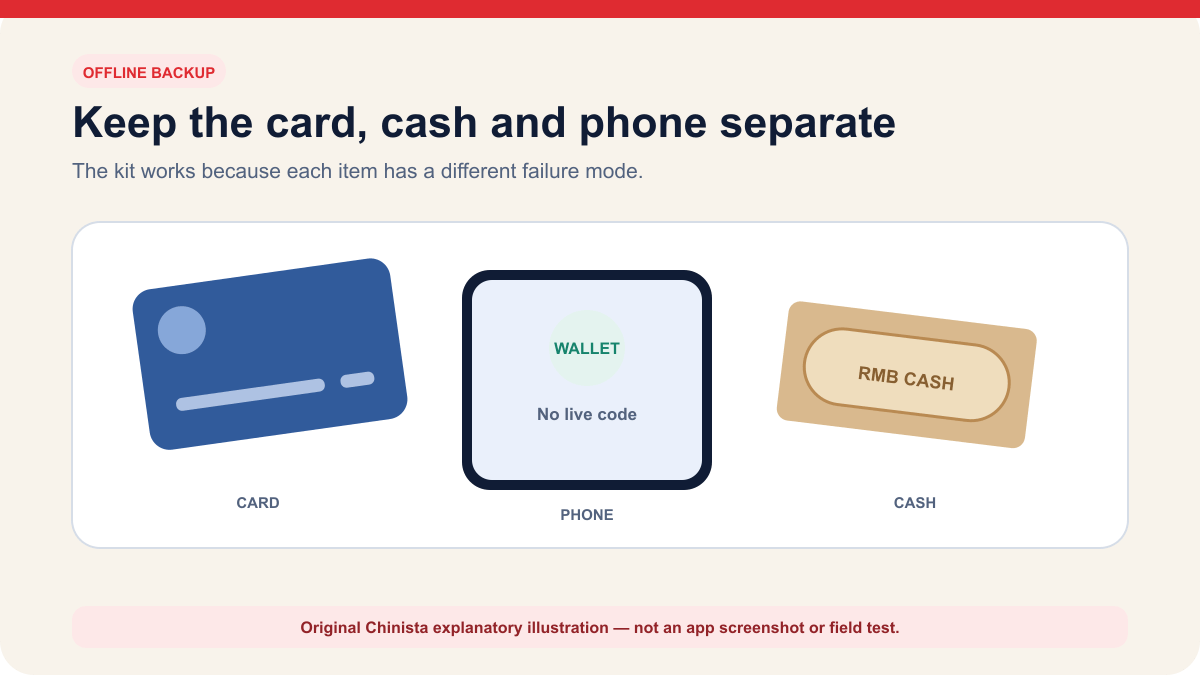
- Keep cards and cash in separate places so one lost wallet does not remove every option.
- Plan a small merchant purchase as the first live wallet test after arrival.
Continue the setup
Tasks connected to this guide
When Plan A fails
Fallbacks and safety checks
- Check wallet history, your card account and the merchant order before paying again. Use a fallback only when failure is clear, no pending or successful record remains, and the merchant confirms the order is unpaid.
- If card binding fails, check the in-app message, then contact the wallet provider or issuing bank.
- Never hand a stranger your phone, passcode or one-time verification code.
Common questions
Frequently asked questions
Can foreign visitors use mobile payments in China?
Chinese government guidance says overseas visitors can use mobile payment services, bank cards and cash. Account eligibility, identity checks and card acceptance still depend on the payment provider and issuing bank.
Should I carry cash in China?
Yes. Keep a modest amount of RMB as an independent fallback even if mobile payment works during testing. Do not rely on cash alone for every purchase.
What should I do if a wallet payment fails?
Check wallet, bank and merchant records first. If payment clearly failed, no pending or successful record remains, and the merchant confirms the order is unpaid, use an accepted fallback. Stop new attempts for a pending or unknown result; ask the merchant to trace a successful payment it cannot match. Changing methods does not cancel an earlier attempt.
Do I need a Chinese phone number for Alipay or WeChat Pay?
Current Chinese government guidance says foreigners can register payment apps with foreign or Chinese mobile numbers. The number still needs to receive the verification method required by the current app.
What fees apply when I use an international card in Weixin Pay?
The standard Weixin Pay international-card service fee is waived at RMB 200 or less; above RMB 200 it is 3 percent of the entire transaction amount, unless an applicable waiver reduces it. Tencent's May 27 to December 31, 2026 campaign covers first-time international-card linking: after the first purchase, eligible users get 90 consecutive calendar days with up to RMB 1,000 of spending per day exempt from that fee. Confirm eligibility, remaining allowance and end date in the app, and read the checkout fee. Issuer foreign-transaction or exchange charges may still apply.
What is the mobile-payment limit for an overseas visitor?
Government guidance gives a policy ceiling of USD 5,000 for one transaction and USD 50,000 per year. The wallet, merchant and issuing bank can apply lower limits, so the amount shown in the app controls the purchase.
Evidence
Primary sources
Source list last checked: .
- Chase UK — pending card transactions (issuer example; checked 20 September 2026)
- State Council payment guide for overseas visitors
- 2025 guide to working and living in China
- Tenpay 2026 international-card service fee rules
- Tencent May 2026 international-card fee-waiver announcement (Chinese)
- Shanghai government payment methods for foreigners