Money & payments
Source checkedCash in China for Visitors: When You Still Need RMB
Do you still need cash in China? Where to get RMB, the 2026 cash-acceptance rule, and what to do if a business refuses cash. Source-checked.
The short answer
Use a mobile wallet as your default, but carry RMB cash as the independent fallback. Cash cannot be refused at a staffed business under the 2026 regulation, and banks are directed to serve the cash needs of overseas visitors.
Jump to a section
Step by step
What to do
- 01
Carry a small, usable amount of RMB
Carry a modest amount of RMB, enough for a taxi, a meal and an emergency. Small denominations help when a vendor lacks change.
- 02
Get cash from a bank ATM or branch
Withdraw RMB from an ATM with your foreign card, or use a bank branch counter with your passport. If one ATM rejects your card, try another machine or a branch rather than assuming cash is unavailable.
- 03
Keep cash for places where your wallet or card fails
Use your mobile wallet where it works. Carry cash for app, network or card failures, and for street taxis, small vendors and machines that do not take your card.
- 04
Know that cash cannot be refused at a staffed business
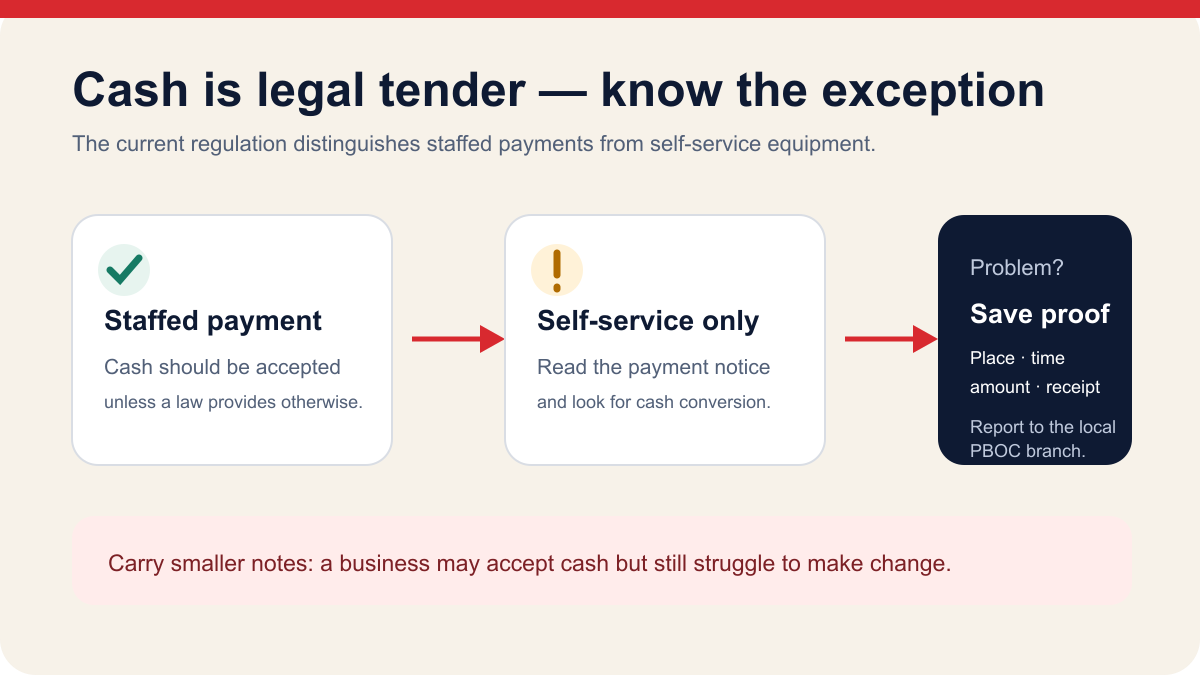
Under the 2026 cash-acceptance rule, a staffed shop, restaurant or stall must accept cash. Self-service kiosks and unified-card zones may be non-cash, but must post a cash-conversion option.
Why carry cash in 2026
A working mobile wallet will handle most everyday payments in China. Keep some RMB cash independently of that setup so you can still pay when the app stops working, the network is unavailable or your linked card is declined. You can hand over cash without waiting for a phone signal, bank approval or a QR code to load.
Use cash when your main payment method fails or mobile payment is awkward. You may need it at a street stall, during a rural stop or at a machine that does not take your card. Carrying this backup lets you make those purchases without depending on the wallet for every transaction.
Carry a modest amount that can cover a taxi, a meal and unexpected needs overnight. Consider those costs when deciding how much to bring, while avoiding a large sum that could make you a target for theft. Keep the reserve within what you can afford to lose.
- Keep RMB available if your main payment method fails.
- Keep a small, usable amount for taxis, small vendors and machines.
- Do not carry more cash than you can afford to lose.
The 2026 rule that protects cash
China's Renminbi Cash Acceptance and Service Regulations were issued as Announcement No. 29 of 2025 by the People's Bank of China, the National Development and Reform Commission and the National Financial Regulatory Administration on 27 November 2025. They took effect on 1 February 2026.
The regulations explicitly prohibit businesses from refusing cash, asking or encouraging others to refuse it, or discriminating against cash payments. RMB cash is legal tender.
The regulations also direct banks to consider the cash-service needs of overseas visitors, alongside elderly people and people with disabilities, and to maintain emergency cash services. Overseas visitors are explicitly included among the groups whose needs banks must consider when providing these services.
| Situation | Can cash be refused? | What to expect |
|---|---|---|
| A staffed shop, restaurant or market stall | No; refusing cash is prohibited | Cash must be accepted unless a law requires a non-cash tool |
| An unattended kiosk or self-service machine | The machine itself may be non-cash | The operator must state the payment method, cash-conversion method and service phone, and address special cash needs |
| A park, campus or other unified-card site | The card-only point may not take notes directly | The site must provide convenient cash top-up and card-return service |
| A service completed entirely online | It may use a disclosed online payment method | The operator must state the payment method in advance; this differs from a staffed face-to-face sale |
Getting RMB cash
You can withdraw RMB from an ATM with a foreign bank card where your card network and issuer are supported. Acceptance varies between machines, so a rejection at one ATM does not mean cash is unavailable. Try another ATM or ask at a bank branch counter if the first machine cannot accept your card.
Bank branches with currency-exchange signs and qualified exchange outlets can exchange supported foreign currencies. Bring your passport and ask the branch what documents and currencies it handles before joining a queue.
Airport exchange counters are convenient, while bank, ATM and exchange-outlet costs vary. Review the displayed exchange rate and every fee before confirming instead of assuming that one channel is always cheaper.
Exchange and denominations
RMB banknotes come in denominations from the 1-yuan note up to the 100-yuan note, with the 1-yuan, 5-jiao and 1-jiao coins below that. A 100-yuan note is the common large note; carrying a few 20s, 10s and some coins makes small purchases and exact change far easier.
When exchanging or withdrawing cash, ask for smaller notes as well as large ones. A taxi driver or small stall may not have change for a 100-yuan note first thing in the morning. A mix of denominations makes it easier to pay the exact amount or use a note they can change.
Exchange rates and fees depend on the bank, card issuer, ATM network and exchange outlet. Check the rate and any fee before confirming; no single channel is guaranteed to give every traveler the best effective rate.
Plan where to withdraw more cash after settling in, so you do not need to carry the whole trip's cash from the airport.
- Carry a mix of denominations, not only 100-yuan notes.
- Compare the displayed rate and fees before choosing an ATM or exchange counter.
- Check the rate and fee before committing to an exchange.
Where cash is inconvenient
Cash is difficult to use for some services, even though it remains useful for staffed purchases. A ride booked through Didi is charged in the app, an online delivery order is paid through the app and a self-service kiosk may have no cash slot. Keep mobile payment available for these situations.
Use a wallet for those services and keep cash for backup and small vendors. Staffed businesses remain subject to cash-acceptance rules, but cash alone will not cover every purchase.
A street taxi will generally take cash, and a staffed shop or restaurant must take cash under the 2026 rule. Keep small denominations so a vendor who genuinely lacks change can still settle your purchase.
What to do if cash is refused
If a staffed business refuses cash, record the merchant, time, location and what happened without confrontation. Article 15 allows members of the public to seek legal protection from the local branch of the People's Bank of China.
Avoid an argument at the counter. For the immediate purchase, use your wallet or shop elsewhere, then use your evidence to make a complaint.
The regulations address widespread and persistent cash refusal. Reporting a refusal is one way to use the protection they provide.
- Note the merchant, time and location, and keep evidence without confrontation.
- Solve the immediate purchase with another method, then report the evidence to the local branch of the People's Bank of China.
- Keep small denominations to avoid change-related friction.
Continue the setup
Tasks connected to this guide
When Plan A fails
Fallbacks and safety checks
- If a machine rejects your card, try another ATM or a bank branch counter with your passport.
- If a staffed business refuses cash, keep non-confrontational evidence and report it to the local branch of the People's Bank of China, as the regulation directs.
- Keep small denominations so a change problem does not block a purchase.
- Never hand a stranger your card, PIN or phone during a cash or exchange transaction.
Common questions
Frequently asked questions
Do I still need cash in China in 2026?
Yes, as a fallback. Mobile payment is the default, but cash keeps working when the app, network or card fails, and it is the practical option for street taxis and small vendors.
Can a business refuse my cash in China?
Under the Renminbi Cash Acceptance and Service Regulations, effective 1 February 2026, a staffed business may not refuse cash, ask or induce others to refuse cash, or treat cash in a discriminatory way, except where a law requires a non-cash tool.
Which government agencies issued the 2026 cash rule?
The People's Bank of China, the National Development and Reform Commission and the National Financial Regulatory Administration issued Announcement No. 29 on 27 November 2025. The regulation took effect on 1 February 2026.
Where can I get cash in China?
Use an ATM displaying your card network, or exchange currency at a bank branch or qualified exchange outlet. Rates and fees vary, so review the displayed terms before confirming rather than assuming one channel is always cheaper.
Are self-service kiosks allowed to be cashless?
An unattended kiosk or self-service machine may take only non-cash payment, but it must post its payment method, a cash-conversion option and a service phone number under the 2026 rule.
What should I do if a business refuses cash in China?
Keep a note of the merchant, time and location without escalating the dispute. Article 15 of the regulation says the public may preserve evidence and seek protection from the local branch of the People's Bank of China.
Evidence
Primary sources
Source list last checked: .