Local transport
Source checkedChina Metro & Bus Guide for Foreign Travelers
Use single tickets, local transport cards, ride codes or cash for metros and buses in China. Check the rules for your city and save a backup route.
The short answer
There is no single nationwide tourist transit code. Start with the local operator's single ticket or staffed counter, then test a local transport card or app ride code if you will ride often. Keep the destination, station exit and bus stop in Chinese, plus exact RMB for buses where cash is accepted. A payment QR code is not the same as a metro or bus ride code.
Jump to a section
Step by step
What to do
- 01
Save the route in Chinese
Record the line or bus number, direction, interchange, destination stop and metro exit. For buses, save the stop before your destination.
- 02
Check how to pay in your city
Use a single ticket, staffed counter, local physical card, supported ride code or exact cash for buses. Check local signage instead of assuming another city's method works.
- 03
Test entry and exit
A metro gate or distance-priced bus may require a tap or scan at both ends. Keep the ticket or card and verify the trip closes successfully.
- 04
Check the direction and exit
Use the terminal station or route direction and identify the correct surface exit before arrival. Ask staff when a gate or route is unclear.
- 05
Plan how to get back after the last service
Check last-service information on the travel date and save the official taxi or verified ride-hailing path before a critical connection.
Check how to pay in your city
Metro and bus fares, operators, transfers and payment methods vary by city. There is no single nationwide tourist ride code or bus card. The Ministry of Commerce's 2025 guide lists single-journey tickets, local transport cards, supported app ride codes and RMB cash for buses. Check which your station or operator accepts.
For a short visit, a staffed counter or single-journey ticket can be easier to use if an app requires identity checks, an international card and a network connection. If you will travel frequently in one city, try a physical transport card or ride code on one journey before relying on it.
A wallet payment code may not work at metro or bus gates. Transport codes are separate options and may require you to select the city, verify identity and accept terms. Set yours up before reaching the gate and test it on a simple trip.
| Method | Best use | Main risk | Fallback |
|---|---|---|---|
| Single-journey ticket | First ride or occasional metro use | Machine language or card acceptance | Staffed ticket counter and RMB |
| Physical transport card | Repeated metro and bus trips in one city | Deposit, refund and city-specific rules | Keep purchase receipt and remaining cash |
| App ride code | Frequent rides after successful setup | Identity, network, city or payment failure | Physical ticket or card |
| Bus cash fare | Simple independent fallback where accepted | No change and variable fare collection | Exact small notes or coins; ask the driver |
| Contactless foreign card | Cities and gates that explicitly support it | Not nationwide and card may decline | Use the local published alternative |
Take a metro from entrance to exit
Search the station by its Chinese name and line, then check the entrance letter or number. Large interchanges and railway stations can have multiple buildings and exits. At the ticket machine or counter, select the destination or fare requested by the local system. Keep the ticket or card until you have exited; some systems require it at both gates.
Pass the security check and follow the line number, direction or terminal station shown on signs. The terminal name can be more reliable than a compass direction. On the platform, verify the next station before boarding. Keep bags controlled, let passengers leave first and move away from the doors. Announcements and signs often include English, but do not rely on that at every station or during disruption.
Before arrival, find the exit closest to your destination entrance. A wrong exit can leave you facing barriers, wide roads or a long walk. If your ticket will not open the gate, ask at the staffed service point for help with the fare or card error. Do not follow another passenger through.
Set up and test an app ride code
The Ministry of Commerce guide gives Alipay as an example: open Transport, select your city, complete identity verification and obtain the relevant metro or bus code to scan at the gate or on the vehicle. Menus may change, and some operators have their own apps. Follow the current screen and local operator instructions.
Confirm the city before the first scan. A metro code and bus code may be separate. Bind a supported payment channel, but keep the physical card and RMB fallback because the issuer, wallet or operator may decline. Never ask a stranger to lend an account or phone number and never share a verification code with someone claiming to activate transport.
Check how to exit as well as enter. Some buses require a second scan when you get off to calculate the distance fare. If scanning fails, step aside and read the error before trying a correction. Switching repeatedly between codes at a busy gate can leave incomplete trips or duplicate charges.
Take a public bus without missing the stop
Save the route number, boarding stop, direction, destination stop and one stop before it in Chinese. Stops on opposite sides of a road can share a name while serving different directions. At the stop, check that the route panel includes the destination. Real-time map information is useful, but the sign and vehicle route number remain the immediate check.
The official national guide says foreign travelers can use RMB cash, local bus cards or supported app codes. Cash fares often require exact small change. Some routes have flat fares; others calculate by distance and may require tapping or scanning both on and off. Ask the driver or follow the vehicle prompt when uncertain. Do not assume another passenger's behavior applies to your route.
Track progress with the Chinese stop list and press the stop button if the route uses request stops. When leaving, look both ways for bicycles and scooters before stepping into or across a cycle lane. If you pass the stop, stay on the vehicle until a safe next stop rather than trying to force the doors or distract the driver.
- Keep exact small RMB notes or coins for buses that accept cash.
- Save the destination and previous stop in Chinese.
- Confirm whether the route requires a second tap or scan on exit.
- Stand clear of cycle lanes when boarding and alighting.
Check local cards and contactless payments
Beijing's official visitor pages describe BEIJING PASS, Alipay ride codes, ticket machines and staffed counters. They also describe contactless entry with supported overseas-issued Visa or Mastercard cards on specified urban rail services. Check the local operator before expecting the same options in Shanghai, Guangzhou, Chengdu or another city.
A transport card bought in one city may not support every route in another, even when a national interoperability logo appears. Refunds, deposits, balance recovery and airport express lines can have special rules. Before buying a large stored value, ask where the card works and how any balance is refunded.
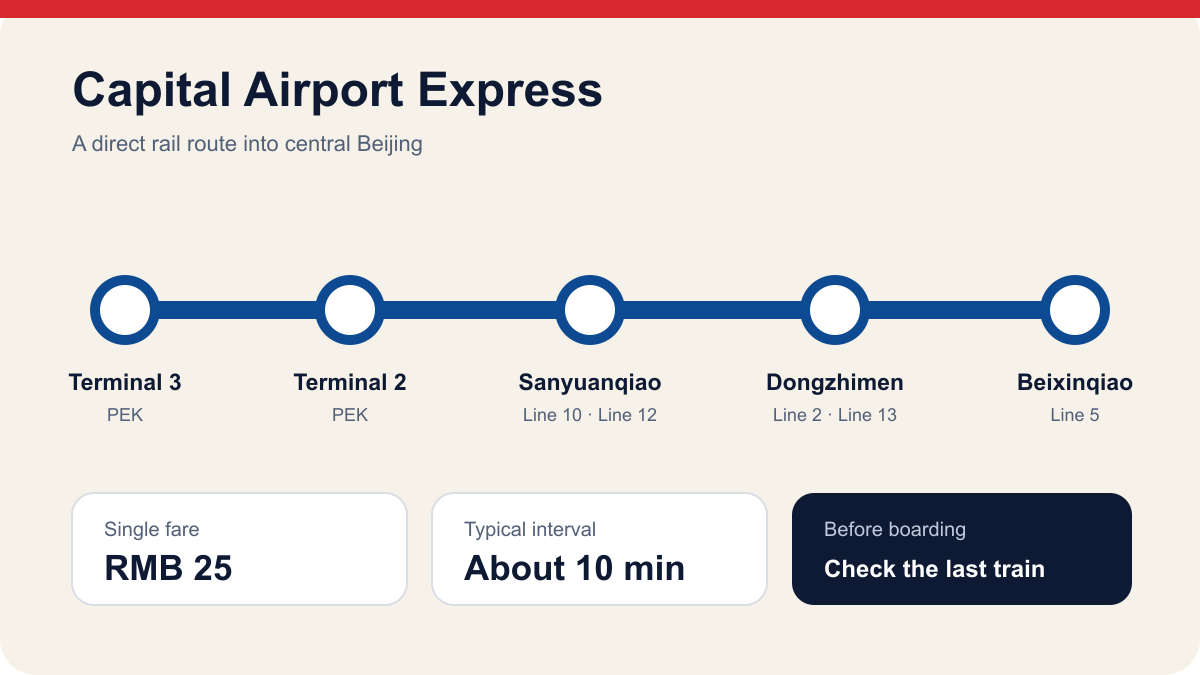
Check the operator's current hours, last trains and disruptions on your travel date, especially for airport and railway connections. Allow extra time and know where to find an official taxi queue or book a ride. A scheduled time shown in a map app may not reflect a service change.
If a gate, card or route fails
If a gate rejects the ticket or code, do not climb, tailgate or keep scanning. Move to the service center and show the ticket, last station and payment record. A ride code may have an incomplete trip that staff or in-app support must close. Keep screenshots of the error and transaction time, but hide payment codes and sensitive identifiers.
If you lose a transport card, ask the operator whether it can recover the balance and whether registration is required. Beijing warns of limits on loss reporting and refunds for its tourist card. Keep only a reasonable balance and carry it separately from your passport. A physical ticket, card or cash can also help if your phone dies.
If you are on the wrong train or bus, get off at the next safe station or stop and rebuild the route. Do not cross tracks, enter staff-only areas or accept a private ride from someone who approaches you. At night, move to a staffed, lit place, show the destination in Chinese and use the official taxi queue or a ride-hailing booking you can verify in the app.
Continue the setup
Tasks connected to this guide
When Plan A fails
Fallbacks and safety checks
- If an app code fails, move out of the queue and use the staffed counter, single ticket, physical card or cash instead of repeated scans.
- If a bus requires exact fare, use small RMB notes or coins and ask whether a second tap or scan is required on exit.
- If you miss a stop, leave at the next safe stop and rebuild the route; never force doors or enter staff-only areas.
- If the last service has ended, move to a staffed lit area and use an official taxi queue or verified ride-hailing booking.
Common questions
Frequently asked questions
Can foreigners use the metro in China?
Yes. Common paths include single-journey tickets, local transport cards and supported app ride codes. The exact ticket, identity and payment rules come from the city operator, not one national system.
Can I use Alipay for China metro and buses?
Some cities support Alipay transport codes after city selection and identity verification, as described in official guidance. The code, operator and payment channel must still be supported locally and pass a real test.
Can I pay cash on a public bus in China?
Official guidance lists RMB cash as a bus option, but local routes and fare collection vary. Carry exact small change because buses commonly do not provide change, and follow the vehicle's current instruction.
Can I tap a foreign bank card at China metro gates?
Only where the local operator explicitly supports that card and gate. Beijing publishes support for specified overseas-issued Visa and Mastercard cards, but this is not a nationwide promise.
Do I need to scan when leaving a bus?
Some distance-priced systems require a second scan or tap, while flat-fare routes may not. Follow the vehicle prompt or ask the driver rather than copying another passenger.
What should I do if my transport QR code fails?
Step away from the gate, check the city, code type and payment status, then use staff or an independent ticket method. Do not keep scanning or tailgate through the gate.
Evidence
Primary sources
Source list last checked: .