Arrival day
Source checkedBeijing Capital Airport to the City: PEK Arrival Guide
Choose your transfer from Beijing Capital Airport, prepare a way to pay and save directions you can use without mobile data.
The short answer
At Beijing Capital International Airport (PEK), pick the Airport Express for a fixed-price, frequent ride, or an official taxi or Didi for a direct drop-off. Keep the hotel address in Chinese and RMB cash as the fallback. This guide does not cover Beijing Daxing Airport (PKX).
Jump to a section
Step by step
What to do
- 01
Prepare data, payment and the hotel address
Before you board, complete your SIM or eSIM provider's setup, confirm the plan covers mainland China, link a payment method, and save the hotel name and address in Chinese offline. Because destination roaming cannot be proven from home, keep a route that works without data.
- 02
Pick the transfer before you land
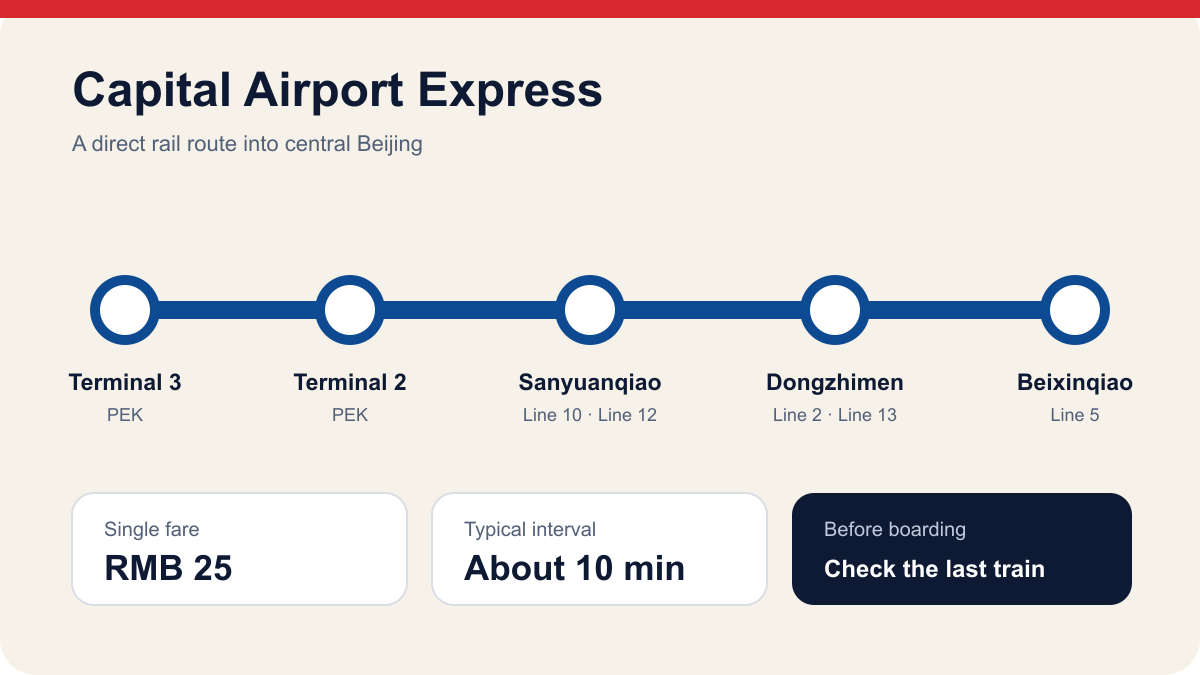
Choose your route before landing, while you have time and an internet connection. The Beijing Capital Airport Express runs from Terminal 3 and Terminal 2 to Beixinqiao via Dongzhimen and Sanyuanqiao for a flat 25 yuan, roughly every 10 minutes. A taxi or Didi costs more but takes you to the door.
- 03
Buy the ticket with a working method
Pay for the Airport Express at a ticket machine, or use a linked mobile payment or transit QR code where accepted. Keep RMB cash as a fallback because a machine or app can decline when a foreign card is involved.
- 04
Save the last departure time
The Airport Express does not run all night. From Terminal 3 the last train leaves around 22:52 and from Terminal 2 around 23:10. If you land after that, plan a taxi or Didi from the start.
- 05
Keep the hotel address in Chinese ready
Save the hotel name and address in Chinese characters so you can show a driver or ask staff for help, even without mobile data.
Compare the transfer options before arrival
From Beijing Capital International Airport (PEK), a common first-arrival airport for visitors, you can reach the city by Airport Express, metered taxi, Didi or airport bus. Compare the fare, service reliability and operating hours for your arrival.
Choose a transfer before landing and save the details. It is harder to compare options in the arrivals hall if you have no data or your phone battery is flat.
| Option | Price | Runs until | Best when |
|---|---|---|---|
| Airport Express | Flat 25 yuan per single trip | Last train ~22:52 (T3) / ~23:10 (T2) | You land before the last train and want a fixed, reliable price |
| Metered taxi | Metered; varies by distance and time | Airport taxi service is the overnight fallback; queue conditions vary | You want a door-to-door ride and can show the Chinese address |
| Didi ride | Estimate shown in-app; varies | Subject to current driver availability and airport pickup rules | Your booking path, payment and data already work |
| Airport bus | Lower than taxi; varies by route | Varies by route | Budget option when you know your route and stop |
Take the Airport Express if its hours suit your flight
The Beijing Capital Airport Express runs from Terminal 3 and Terminal 2 to Beixinqiao, stopping at Sanyuanqiao and Dongzhimen on the way. The official Beijing Capital International Airport website lists a flat single-trip fare of 25 yuan and a frequency of roughly every 10 minutes.
The frequent service and fixed 25 yuan fare make the Airport Express a straightforward first-arrival option. Taxi and Didi costs vary with traffic and distance.
Check the last train against your arrival time: departures finish around 22:52 at Terminal 3 and 23:10 at Terminal 2. If you land after those times, plan on a taxi or Didi.
Each stop connects to the wider subway: Sanyuanqiao to Lines 10 and 12, Dongzhimen to Lines 2 and 13, and Beixinqiao to Line 5. Use those connections only if your hotel is close to a station, because a first-day transfer with luggage and a language barrier is easiest when you minimize changes.
Taxis and Didi for a direct drop-off
A metered taxi takes you directly to the hotel door, which is worth the higher price when you have luggage, a late arrival, or a hotel far from a subway station. Use the official taxi rank rather than accepting a ride from someone who approaches you inside the arrivals hall.
A Didi ride normally shows an estimate before confirmation. Airport pickup instructions and contact controls depend on the current app and terminal, so follow the live pickup directions and keep the Chinese hotel address ready if the driver calls.
For either ride, save the hotel's Chinese name and address on your phone and paper. Show them to the driver or a helper if you cannot use the map or explain the destination.
Paying for the transfer
Airport Express tickets can be bought at the airport ticket facilities; Beijing's English service page says staff at the Beijing Service counter can assist at self-service machines. Payment methods can change by machine, so follow the displayed options and keep another method ready.
Keep RMB cash and a linked mobile wallet available for the first transfer. A machine or app may decline a foreign card even when there is enough money in the account, so have another way to pay.
If the payment fails at the machine, do not keep retrying the same charge. Use the cash or the mobile payment instead, and sort out the declined card later from a calmer position.
Arriving with no data
Before boarding, complete your provider's installation steps, confirm the plan covers mainland China and save the transfer details offline. You can only test roaming at the destination after arrival, so prepare a route you can follow without data.
If you land with no working data, go to the airport information or Beijing Service counter or the official taxi rank and show the Chinese hotel address. Airport Wi-Fi may also help, but do not make it the only offline plan because access requirements can vary.
Write down the hotel's Chinese address before departure and keep it where you can show it even if the phone stops working.
Prepare for late arrival or a phone problem
Check your landing time against the last Airport Express departure. If the train has stopped running when you arrive, use a taxi or Didi.
Keep RMB cash, a physical card and the hotel's Chinese address accessible. These give you alternatives if a payment is declined, the phone battery dies or you cannot explain the destination.
Do not share payment codes, login codes or remote screen access with someone offering to arrange a transfer. Keep control of your accounts and use the official transport options.
- Confirm the landing time against the last train before relying on the Airport Express.
- Keep RMB cash, a physical card and the Chinese hotel address as three independent fallbacks.
- Use the official taxi rank or a Didi booked in-app; never a ride offered by a stranger in the hall.
Continue the setup
Tasks connected to this guide
When Plan A fails
Fallbacks and safety checks
- If your SIM or data does not work, use airport Wi-Fi or ask the information desk for a taxi queue and show the Chinese hotel address.
- If the Airport Express has stopped for the night, use the official taxi rank or book a Didi; do not accept a ride from someone who approaches you in the arrivals hall.
- If a payment is declined, keep RMB cash for the fare and for a metered taxi.
- Never share payment codes or screen control with someone offering to arrange your transfer.
Common questions
Frequently asked questions
How do I get from Beijing Capital Airport to the city?
The Beijing Capital Airport Express runs from Terminal 3 and Terminal 2 to Beixinqiao via Dongzhimen and Sanyuanqiao for a flat 25 yuan per single trip, roughly every 10 minutes, with transfers to subway Lines 2, 5, 10, 12 and 13 at those stations. A taxi or Didi is a door-to-door alternative.
How much does the Beijing Airport Express cost?
The official Beijing Capital International Airport website lists a flat single-trip fare of 25 yuan for the Airport Express. A taxi or ride-hailing trip is a range that depends on distance, time and vehicle type.
What time is the last Airport Express train?
The last train leaves Terminal 3 around 22:52 and Terminal 2 around 23:10, with the first train from Beixinqiao around 05:56. If you land after the last train, plan a taxi or Didi.
Can I pay for the airport transfer with a foreign card?
Payment acceptance can differ by machine, app and merchant. Keep RMB cash and a linked mobile payment as alternatives, and do not rely on a single foreign card for the first transfer.
What should I do if I have no data at the airport?
Use the airport Wi-Fi, save the hotel address in Chinese characters offline before you land, and use the official taxi rank or information desk. A written Chinese address lets a driver or helper route you without an app.
Is it safe to take a taxi from Beijing airport?
Use the official taxi rank or a Didi booked in the app. Do not accept a ride from someone who approaches you inside the arrivals hall, because an unlicensed driver cannot offer the same protections.
Evidence
Primary sources
Source list last checked: .