Entry & visas
Source checkedDo US Citizens Need a Visa for China? 2026 Entry Guide
Most US tourist trips to mainland China need a visa before arrival; check the narrow transit exception and current US application process.
The short answer
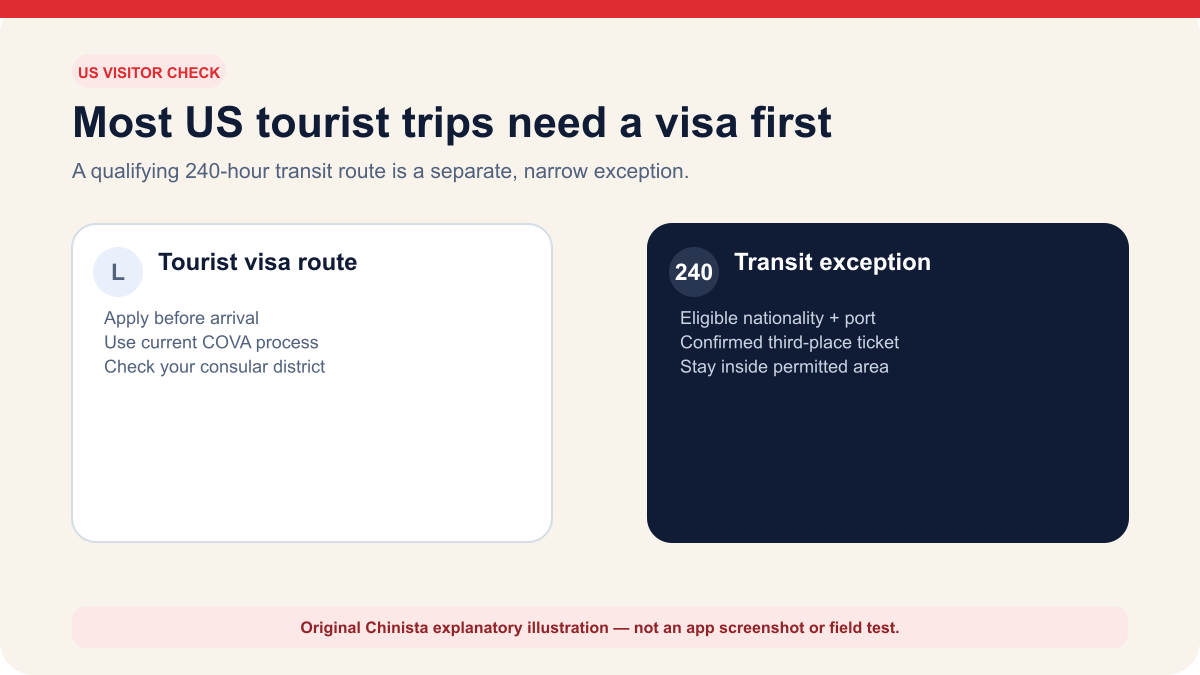
For an ordinary US tourist trip to mainland China, plan to obtain a visa before arrival. The main short-trip exception is a qualifying 240-hour transit route through an eligible port to a different country or region; it is not a substitute for a normal China round trip.
Continue the setup
Tasks connected to this guide
Step by step
What to do
- 01
Separate mainland China from Hong Kong and Macao
This page answers entry to mainland China. Hong Kong and Macao maintain separate immigration systems, so a trip that includes them can contain different entry rules for different legs.
- 02
Check whether a narrow exemption actually fits
A US passport is eligible for the 240-hour transit policy only when the route, confirmed onward ticket, entry port, permitted area and other NIA conditions fit. Do not relabel a simple US–China round trip as transit.
- 03
Use the current US visa application process
For a tourist visa, start with the official COVA system, submit the requested digital materials and wait for the order status that tells you to submit the passport. Follow the consular district responsible for your US residence.
- 04
Build time for review, not only the published service time
The Embassy lists four working days for regular processing and three for urgent service after passport submission, while warning that individual cases can take longer. Apply with margin and do not buy an inflexible trip around the shortest number.
The 2026 answer for an ordinary US tourist trip
An ordinary US passport holder planning a normal tourism visit to mainland China should expect to obtain a visa before arrival. The Chinese Embassy's visa-waiver FAQ updated in February 2026 lists 50 nationalities covered by the current unilateral 30-day waiver; the United States is not on that list. The absence of the United States from one waiver does not mean every US traveler needs a visa in every circumstance, because transit and other narrow exemptions use separate rules.
The most relevant short-visit exception is the 240-hour visa-free transit policy. A US citizen is one of the eligible nationalities, but the itinerary must be genuine transit from A through an eligible mainland port to a different country or region B, with a confirmed onward ticket inside the limit and travel inside the permitted area. A US → China → US holiday is not converted into transit by staying fewer than ten days.
This page covers mainland China. Hong Kong and Macao have separate immigration systems, and entry to either does not by itself authorize entry to the mainland. The passport, purpose and exact sequence of places decide the answer. Start with those facts before reading a social post that says China is visa-free or that Americans always need a visa; both statements are too broad.
| Planned trip | Likely path | What controls |
|---|---|---|
| US → mainland China → US | Tourist visa before arrival | Current Chinese Embassy L-visa instructions |
| US → mainland China → Japan | May fit 240-hour transit | Nationality, port, ticket, permitted area and time conditions |
| US → Hong Kong → mainland China → US | Mainland leg usually needs a visa unless a separate exemption fits | Hong Kong and mainland entry are separate decisions |
| Work or long study in mainland China | Purpose-specific visa | Tourist and transit routes do not authorize the activity |
Decide in the right order: passport, purpose, route, duration
First identify the passport that will be used for the reservation and at the border. Residence in the United States, a US visa or a second nationality does not substitute for the nationality printed in the travel document presented. A dual national should check the consequences of each passport and keep one identity consistent across the airline, visa and booking records.
Second, name the real purpose. Tourism normally points to an L visa. Work, study, journalism and residence use different categories and may require approvals before the visa application. Applying as a tourist because the form looks easier can create a mismatch at review or entry. A short business meeting and employment are not interchangeable simply because both trips are brief.
Third, write the route in full, including Hong Kong, Macao and every mainland entry. Then test any claimed exemption against that exact route. Fourth, compare the planned duration with the rule. Do not choose the desired answer first and redesign the explanation afterward. Immigration decisions are document-based, and the tickets, hotel records and stated purpose should tell one coherent story.
How the current US tourist-visa process works
The Chinese Embassy in Washington introduced the new COVA online function on 30 September 2025. Applicants start in the official online system, complete the form and upload the materials requested for the visa category, then wait for the preliminary review. When the order shows the status for passport submission, the applicant or an agent can deliver the original passport and the order information required by the responsible mission. Follow the consular district for the applicant's US residence rather than choosing an office only because flights are cheaper there.
For an L tourist visa, the Embassy instructions state that since 1 January 2024 applicants in the United States generally do not need to provide round-trip tickets, hotel orders, an itinerary or an invitation letter as core material. That simplification is not a promise that no additional evidence will ever be requested. The same page warns that individual circumstances differ and the consular office's current request controls.
Use only the official COVA entry or a Chinese embassy or consulate page. A paid agency may help organize paperwork, but it cannot guarantee approval and should never receive a password that also protects unrelated accounts. Keep a copy of the submitted form and review names, passport number, intended entries and validity as soon as the issued visa is returned. Report an error before travel rather than explaining it at airline check-in.
- Use the official COVA system linked by the responsible Chinese mission.
- Wait for the order status that instructs passport submission.
- Submit the original passport and the required order page and supporting originals.
- Check the issued visa's name, passport number, entries and validity immediately.
Prepare the passport and case-specific documents
The Embassy's current US instructions call for images of the passport information page and blank visa pages. The passport should have more than six months' remaining validity and at least two blank visa pages. The instructions also list evidence of the applicant's US residential address, such as a driving licence, utility bill or bank statement. A non-US citizen applying in the United States needs evidence of lawful US stay or residence.
Previous Chinese visas or residence permits, an old passport containing a still-valid document, former Chinese nationality, a name change or a child of Chinese descent can trigger additional records or original-document requirements. These are not edge cases to hide from the form. Answer the history questions accurately and provide the material requested for that situation.
The tourist-document waiver should be understood precisely. It removes certain routine itinerary materials from the ordinary core list; it does not weaken the need for a truthful purpose, a usable passport or whatever a consular officer specifically requests. Keep provisional travel plans flexible until the visa is issued. A refundable reservation can reduce trip risk, but buying one does not improve the legal eligibility of the application.
Use the published time and fee as planning inputs, not promises
The Embassy's September 2025 instructions list four working days for regular service and three working days for urgent service, counted from submission of the passport. The same instructions say some applications can take longer and that the timing is uncertain in those cases. Online form completion, preliminary review, travel to the mission, shipping where allowed and holidays sit outside a simplistic four-day countdown.
A separate Embassy notice published in December 2025 extends reduced visa fees through 31 December 2026. It lists USD 140 for US citizens and an additional USD 25 for urgent service. The fee notice is time-limited, so a page that quotes USD 140 without the expiry date will become misleading. Check the live fee page again if applying near or after the end of 2026.
Do not purchase non-refundable transport based on the minimum processing time. Build room for an extra-document request, passport delivery and correction. If the trip cannot move and the application has not reached the expected state, use the visa office's published contact route. An agent promising a special approval channel is not a substitute for the consular decision.
| Item | Official published figure | Planning caution |
|---|---|---|
| Regular processing | 4 working days after passport submission | Some cases take longer |
| Urgent processing | 3 working days after passport submission | Available for urgent circumstances; not guaranteed approval |
| US-citizen fee | USD 140 through 31 December 2026 | Recheck after the stated expiry |
| Urgent surcharge | USD 25 | Added to the applicable visa fee |
Use 240-hour transit only when the route naturally fits
US citizens are included in the current NIA list for 240-hour visa-free transit. To use it, the traveler needs a valid international travel document with at least three months' validity, a confirmed onward ticket to a third country or region within 240 hours, entry through an eligible port and an itinerary confined to the permitted area. The temporary-entry period is calculated from 00:00 on the day after entry, subject to the record issued by border inspection.
This is attractive for a stopover before Japan, South Korea, Hong Kong or another genuinely onward destination. It is fragile when the trip has been built around separate throwaway tickets, a tight self-transfer or travel outside the permitted area. Airline staff can review the route before boarding, and border inspection decides temporary entry after arrival. Eligibility on paper does not compensate for missing proof or an incoherent plan.
If a schedule change removes B, sends the traveler back to A or changes the arrival port, redo the policy check immediately. Contact the carrier and 12367 rather than assuming the original analysis survives. A regular visa is often the better tool for a China-focused holiday because it tolerates an ordinary round trip and gives the itinerary more room to change.
Visa approval is not the end of the operating plan
A visa or visa-free eligibility does not guarantee admission. Carry the passport used for the application, the visa if required and documents that support the stated visit. Border staff may ask about accommodation, onward travel and purpose. Answer accurately and follow the validity, number of entries and duration recorded on the issued document or entry permission.
After arrival, hotels complete accommodation reporting during check-in. A visitor staying at a friend's home, private rental or another non-hotel address must ensure temporary residence registration is completed under the applicable rule. This obligation is separate from the visa. Save the confirmation because it may be needed in later dealings with local authorities or service providers.
Do not work, study or conduct another purpose that the entry route does not authorize. If plans materially change after arrival, contact the local exit-entry administration before the permitted stay ends. The worst time to discover that a tourist entry cannot support the new activity is after beginning it or after overstaying.
Avoid the three shortcuts that create the most risk
First, do not treat a blog's country list as permanent. China's visa waivers have changed repeatedly, and many announcements have explicit end dates. Use an Embassy or NIA page checked close to departure. Second, do not confuse Hong Kong or Macao entry with mainland entry. They can be part of a transit route, but they do not make a US–mainland round trip visa-free by themselves.
Third, do not buy certainty from an unofficial agent. An agent can courier or organize documents where the mission permits, but only the competent authority decides the visa and border entry. Keep login credentials, payment details and identity scans inside official or clearly contracted channels. Ask what the fee covers and whether the passport will be mailed, carried or held.
The robust plan has a dated official source, a passport with margin, flexible bookings and a route that still works if a flight changes. If any of those is missing, fix it before debating application speed. Entry preparation is successful when the documents and the real trip agree, not when the traveler finds the most optimistic sentence online.
When Plan A fails
Fallbacks and safety checks
- If the intended route does not clearly qualify for visa-free entry or transit, obtain the appropriate visa before departure instead of asking the airline counter to solve it.
- If a passport has less than six months' remaining validity or fewer than two blank visa pages, resolve the passport issue before relying on a tourist-visa application.
- If the online order requests extra material, follow the request shown in the official system; a general checklist cannot overrule case-specific consular review.
- If timing is tight, use the Embassy's official urgent-service rules and published contact channel rather than paying an unofficial agent who promises guaranteed approval.
Common questions
Frequently asked questions
Do US citizens need a tourist visa for mainland China in 2026?
Generally yes for an ordinary tourist visit. The United States is not on the Chinese Embassy's February 2026 list of 50 unilateral visa-waiver countries. A qualifying transit or another specific exemption can change the answer for that route.
Can a US citizen use the 240-hour visa-free transit policy?
Yes, US citizens are on the NIA nationality list, but the traveler must also arrive through an eligible port, hold the required passport and confirmed onward ticket, travel to a different country or region and stay within the permitted area.
How much is a China visa for a US citizen in 2026?
The Chinese Embassy's fee notice lists USD 140 for US citizens through 31 December 2026 under the reduced-fee measure. Urgent service adds USD 25. Confirm the current notice when applying because fees can change after that date.
How long does a China tourist visa take in the United States?
The Embassy lists four working days for regular service and three working days for urgent service, counted from passport submission. It also warns that some applications take longer, so these are service targets rather than a guaranteed trip deadline.
What documents does a US tourist visa application need?
Current Embassy instructions require the passport information and blank-page images, a passport with more than six months' validity and at least two blank pages, US address evidence and other records that apply to the individual. Since 2024, ordinary L-visa applicants in the United States generally do not need to submit flight, hotel, itinerary or invitation material, but a consular officer may request more.
Does a valid China visa guarantee entry?
No visa or visa-free rule removes border inspection. Carry documents that support the stated trip, answer accurately and follow the entry decision and permitted stay recorded by the authorities.
Evidence
Primary sources
Source list last checked: .
- Chinese Embassy in the United States — visa-free entry FAQ updated February 2026
- Chinese Embassy in the United States — visa application instructions updated September 2025
- Chinese Embassy in the United States — visa fees through 31 December 2026
- National Immigration Administration — current 240-hour transit conditions